
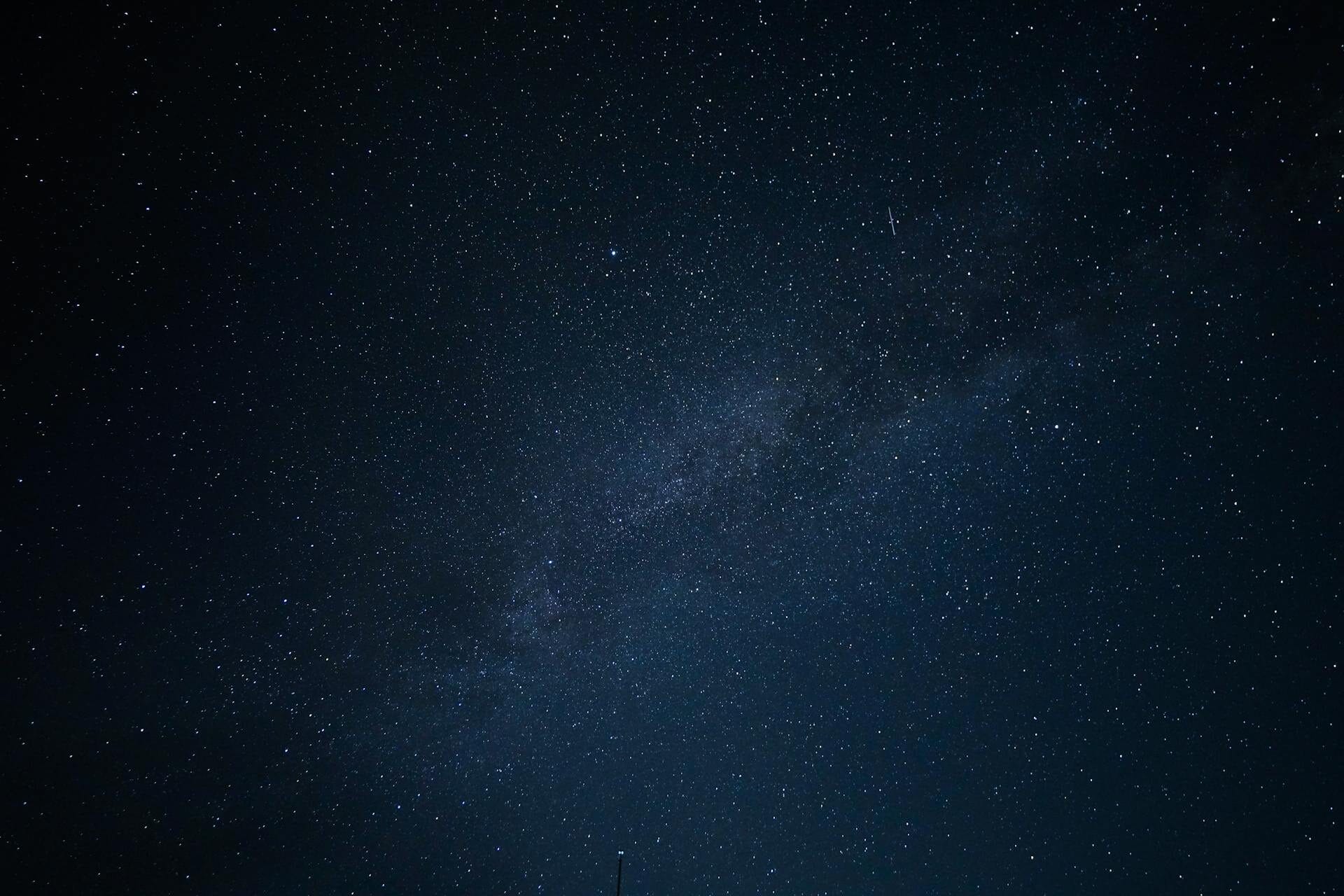
Look up at the night sky, and one fact becomes difficult to ignore: there is an almost incomprehensible amount of space out there.
The Milky Way alone contains roughly 100 billion stars. Planets appear to be common around them, and NASA’s Exoplanet Archive had reached 6,372 confirmed exoplanets by September 25, 2026. Research based on data from the Kepler Space Telescope has even suggested that rocky planets within the habitable zones of Sun-like stars could be relatively common.
None of that means those planets contain life. A world sitting in “a star’s habitable zone” simply occupies a region where liquid water could potentially exist under the right atmospheric conditions.
Still, the numbers raise an irresistible question. If planets are everywhere, the universe has existed for billions of years, and life managed to become intelligent on at least one planet…
“Where is everybody?”
That mystery is usually called the “Fermi Paradox.”
One possible answer is far more unsettling than simply saying alien civilizations are rare. Perhaps almost every civilization eventually encounters a barrier it cannot cross.
That idea is known as “the Great Filter.”
What Is the Fermi Paradox?
In the summer of 1950, physicist Enrico Fermi was having lunch with colleagues at Los Alamos when a conversation about extraterrestrial civilizations led to the question that would become famous: “Where is everybody?”
The exact wording is reconstructed from later accounts, but the underlying question remains powerful.
If intelligent civilizations can arise elsewhere and some become capable of expanding between stars, why don’t we see obvious evidence of them?
- No confirmed alien spacecraft.
- There are no verified extraterrestrial radio transmissions.
- No unmistakable technological structure surrounding another star.
- No confirmed extraterrestrial civilization.
As of 2026, the SETI Institute says that no SETI search has received a confirmed extraterrestrial signal, while NASA says it has found no credible evidence of extraterrestrial life.
At first glance, that sounds like evidence that intelligent life must be incredibly rare. There is a major problem with that conclusion, though. We have barely begun looking.
The Galaxy May Be Quiet—But We Haven’t Searched Much of It
The phrase “Great Silence” can make it sound as though humanity has carefully searched the Milky Way and found nothing. That isn’t what has happened.
Searching for extraterrestrial technology involves far more than pointing a radio telescope at the sky. Scientists must consider direction, distance, signal strength, frequency, bandwidth, timing, repetition, polarization, and many other variables.
Researchers have described this enormous parameter space as the Cosmic Haystack. One quantitative study concluded that humanity has examined only an extremely small fraction of that haystack—roughly comparable to checking the water in a large hot tub or small swimming pool while trying to determine whether fish exist anywhere in Earth’s oceans.
Even the signals themselves may be harder to identify than expected. Research discussed by the SETI Institute in 2026 suggested that activity around alien stars could broaden narrow radio transmissions enough to make some signals more difficult for traditional searches to detect.
So the Fermi Paradox is not proof that aliens don’t exist. Instead, it highlights a tension between what might be possible and what we have actually observed.
The Great Filter is one attempt to explain that tension.
What Is the Great Filter Theory?
Economist and researcher Robin Hanson developed the Great Filter argument in a widely discussed 1998 essay titled “The Great Filter—Are We Almost Past It?”
The central idea is simple. Imagine a sequence beginning with lifeless matter and ending with a civilization capable of surviving for enormous periods of time and expanding far beyond its home world.
Somewhere along that path, one or more steps may be extraordinarily difficult; in fact, almost every world attempting the journey fails. That difficult transition—or combination of transitions—is “the Great Filter.”
The unsettling part isn’t merely that such a filter might exist. It is that we don’t know “where we are relative to it.” Humanity may have already passed the hardest part. Or the hardest part may still be waiting for us.
The Possible Steps Toward an Advanced Civilization
There isn’t one universally accepted list of Great Filter stages, because the idea is a framework rather than an established law of nature. However, the path might look something like this:
A suitable planetary system forms
↓
Life begins
↓
Simple cells survive and evolve
↓
Complex cells develop
↓
Multicellular organisms appear
↓
Intelligence evolves
↓
A technological civilization develops
↓
The civilization survives its technological era
↓
It becomes capable of long-term interstellar expansion
Any one of those transitions might be extremely improbable. Perhaps several are. The problem is that Earth gives us only one known example of a planet where the sequence progressed this far. That makes determining which steps are easy and which are rare incredibly difficult.
Possibility 1: The Great Filter Is Behind Us
This is the more reassuring interpretation. Perhaps humanity has already crossed the most improbable barrier.
Consider the origin of life itself. Despite major progress in chemistry, biology, and planetary science, scientists still do not know exactly how non-living chemistry became the first self-replicating biological systems on Earth. Maybe that transition—known broadly as abiogenesis—is extraordinarily rare.
There could be billions of rocky planets with water, carbon, and suitable temperatures, while almost none spontaneously develop life. If so, Earth passed an astonishingly difficult filter very early.
But another possibility is that simple life appears relatively easily while complex life almost never develops.
Earth provides an interesting clue. Life seems to have appeared relatively early in our planet’s history, yet complex multicellular organisms took billions of years to emerge.
Perhaps the hardest step was the development of complex cells. Maybe multicellularity was the bottleneck. Or perhaps the truly rare event was the evolution of an organism capable of abstract reasoning, language, advanced tools, and cumulative technological culture.
On Earth, countless species have existed. Only one eventually built radio telescopes. That alone should make us cautious about assuming intelligence inevitably follows from evolution.
What If Intelligence Is the Filter?
Evolution does not appear to have a predetermined destination. Natural selection does not “try” to create intelligent beings, spacecraft, or civilizations. It favors traits that improve reproductive success within particular environments.
For billions of years, microorganisms dominated Earth perfectly well without inventing technology. Even after complex animals appeared, enormous evolutionary success did not require mathematics, computers, or astronomy.
Dinosaurs existed for more than 150 million years without developing an industrial civilization. Humans, by contrast, have existed for only a tiny fraction of Earth’s history.
Perhaps technologically capable intelligence is not the inevitable endpoint of evolution. Maybe it is an extraordinary accident.
If that is true, the silence of the galaxy becomes less surprising. Most living planets might never produce anything capable of asking whether it is alone.
Possibility 2: The Great Filter Is Still Ahead
Now we reach the uncomfortable version.
- What if simple life is common?
- Suppose that complex life appears regularly?
- What if technological civilizations have emerged thousands—or millions—of times?
And yet almost none survive long enough to become detectable across astronomical distances. In that scenario, the Great Filter may lie somewhere after technological intelligence develops.
That does not mean there must be one universal doomsday event. Instead, civilizations could encounter multiple dangers as their technological power increases.
Possible bottlenecks might include:
- Nuclear conflict—Technologies capable of producing enormous energy can also produce enormous destruction. The same question becomes even more complicated when nuclear weapons are compared with emerging technologies such as advanced AI.
- Artificial intelligence or other advanced technologies—highly capable systems could create risks through misuse, accidents, poor control, or interactions with critical infrastructure.
- Engineered biological threats—Advanced biotechnology could eventually give civilizations the ability to create organisms more dangerous than naturally occurring pathogens.
- Environmental destabilization — A civilization might damage the ecological systems upon which it depends faster than it can adapt.
- Resource and political instability—Increasing technological power does not necessarily guarantee social stability.
- Cosmic catastrophes—Asteroid impacts, nearby supernovae, gamma-ray bursts, and magnetars, and other astronomical events can occasionally threaten planetary environments.
None of these has been demonstrated to be the Great Filter. They are possible examples of civilization-level bottlenecks.
A civilization might survive one challenge only to encounter another centuries later.
Maybe Technological Power Becomes the Test
There is an uncomfortable pattern in human history. As our knowledge improves, our ability to protect ourselves grows—but so does our ability to cause damage.
- Fire kept early humans alive, yet it could destroy settlements.
- Industrial technology transformed living standards while also making environmental disruption possible on a planetary scale.
- Nuclear physics unlocked enormous scientific and energy potential while also creating weapons capable of devastating cities.
- Artificial intelligence, biotechnology, and increasingly autonomous systems are now extending human capabilities into areas previous generations could barely imagine.
That doesn’t mean technological progress inevitably destroys civilizations. Quite the opposite: technology may ultimately be what allows civilizations to survive asteroid impacts, pandemics, environmental changes and even the eventual evolution of their stars.
The real challenge may be surviving the period when technological power grows faster than the systems used to manage it. If many civilizations fail during that transition, technological maturity itself could function as a filter.
Would Becoming Multiplanetary Help?
One obvious strategy for reducing civilization-level risk is spreading beyond a single world. Today, every human being lives on Earth.
A sufficiently severe planetary catastrophe could therefore affect our entire civilization at once. A future civilization with independent settlements on multiple planets or moons would be harder to eliminate through a single local disaster.
Mars is usually mentioned first, although the science of surviving on Mars shows just how difficult an independent settlement would be. Humans would need protection from radiation, reliable life-support systems, food production, water recycling and solutions to the effects of low gravity.
Interstellar expansion would be dramatically harder still. Nevertheless, the principle is important.
Once a civilization becomes distributed across multiple self-sufficient worlds, some types of existential catastrophe become less capable of destroying it completely.
That may be one reason the Great Filter discussion often ends with interstellar civilization rather than technological civilization alone.
But Why Should Advanced Aliens Colonize the Galaxy?
This is one of the biggest assumptions hiding inside some versions of the Fermi Paradox. Perhaps they wouldn’t.
Early arguments often assumed that sufficiently advanced civilizations would eventually spread from star to star. Some mathematical models have shown that galactic colonization could occur on timescales of millions to tens of millions of years under particular assumptions—extremely short compared with the age of the Milky Way.
However, those models depend on choices about spacecraft speed, settlement behavior, civilization longevity and motivation.
Aliens might have no interest in expansion. They might develop extremely efficient virtual environments. Or They might remain close to their original star systems.
Interstellar travel might prove vastly more expensive than expected. Advanced civilizations might also become difficult for us to recognize.
A civilization does not need to construct enormous glowing monuments announcing its existence. So perhaps the apparent silence doesn’t require civilizations to keep dying.
Maybe our assumptions about what successful civilizations should look like are simply wrong.
Could Advanced Civilizations Be Invisible to Us?
Imagine someone from the year 1500 attempting to search for modern human communication.
They might watch for smoke signals. Meanwhile, billions of messages would be passing invisibly through radio networks, fiber-optic cables and satellites.
Their failure to detect us wouldn’t mean we didn’t exist. It would mean they were looking for the wrong thing.
Human SETI faces a similar problem. Radio transmissions are only one possible technosignature.
Researchers can also search for unusual optical signals, atmospheric pollutants, waste heat, artificial structures, anomalous energy use and other potential signs of technology. Yet any truly advanced civilization could use methods we haven’t imagined. Even something as basic as the duration of a signal matters.
A civilization could transmit while we aren’t listening. Its technological phase might last only a few thousand years. The signal could be too weak. It could operate at frequencies we are not monitoring. Or it may not resemble anything our algorithms classify as artificial.
The universe might therefore be less silent than it appears. We may simply not know how to listen yet. Space has repeatedly shown us phenomena that were once almost impossible to observe directly—from technosignatures we are still searching for to black holes revealed through their effects on surrounding matter.
Would Finding Alien Microbes Be Bad News?
This is one of the most famous—and most misunderstood—consequences of the Great Filter argument.
Suppose we discovered microbes beneath the surface of Mars or inside the ocean of an icy moon. Would that mean humanity is doomed?
No. However, truly independent extraterrestrial life would tell us something important.
If life independently originated both on Earth and another nearby world, then the transition from chemistry to biology might be easier than previously thought.
That would make abiogenesis a less convincing candidate for the Great Filter. Consequently, researchers would need to look more seriously at later evolutionary or technological stages.
Hanson’s original argument is why alien life is sometimes described as potentially “bad news” within the Great Filter framework.
But the conclusion is conditional. Microbes on Mars might share ancestry with Earth life because material has been exchanged between the planets through meteorite impacts. Finding simple organisms also wouldn’t tell us how difficult complex life, intelligence or technological civilization might be.
So discovering extraterrestrial microbes would not prove that a civilization-destroying filter lies ahead of us. It would simply give scientists an extraordinary new data point.
What If We Found an Advanced Civilization?
Now imagine something much bigger. Tomorrow, astronomers detect an unmistakably artificial signal from another star. After repeated observations by independent facilities, there is no realistic natural explanation. Humanity has discovered another technological civilization.
Scientifically, it would be one of the greatest discoveries in history. For the Great Filter, however, it would have fascinating implications.
We would immediately know that Earth is not the only planet where life reached technological intelligence. That would eliminate some explanations for the cosmic silence.
Finding numerous technological civilizations would constrain the possibilities even further. Perhaps advanced civilizations are common but difficult to detect. Maybe interstellar expansion is impractical. Perhaps civilizations remain technologically active without dramatically restructuring their galaxies. Or maybe the assumption behind the Great Filter needs substantial revision.
That is what makes SETI so valuable. Every discovery—and every carefully defined non-detection—gives us slightly more information about which explanations remain plausible.
What If We Never Find Anyone?
That result would also be profound.
Suppose humanity spends centuries examining millions of planets with increasingly powerful telescopes. We detect atmospheres and map oceans. We study potentially habitable worlds. Yet we repeatedly find no convincing biosignatures and no technology.
The case for life being genuinely rare would become much stronger. If even microbial life proved difficult to find, the Great Filter might lie near the beginning of the journey.
Perhaps Earth really did win an extraordinary cosmic lottery. That possibility carries its own weight.
If intelligent life is exceptionally rare, then Earth’s biosphere may be one of the few places where the universe has developed the ability to observe and understand itself. Protecting it would become even more important.
The Great Filter Is Not a Prediction of Doom
The name sounds ominous, which makes the theory easy to turn into a frightening headline. But the Great Filter does not predict that humanity will destroy itself.
It doesn’t tell us that nuclear war is inevitable or it doesn’t prove artificial intelligence will end civilization or it doesn’t show that every technological society collapses. And it certainly doesn’t prove that aliens don’t exist.
The Great Filter is better understood as a way of organizing an extraordinary scientific question:
“Which steps between a lifeless planet and a long-lived, technologically advanced civilization are genuinely difficult?”
Right now, we don’t know. We have only one confirmed inhabited planet. One known technological species.
And no confirmed extraterrestrial civilization for comparison. That leaves an enormous amount of uncertainty.
The Most Important Clue May Be Waiting on Another World
The search for extraterrestrial life isn’t merely about discovering aliens. It could teach us something about ourselves.
Finding simple life could reveal whether biology begins easily. Discovering complex organisms could tell us how often evolution produces sophisticated multicellular life.
Detecting intelligent beings could show whether technological intelligence is a repeatable evolutionary outcome. Finding ancient ruins or extinct technological signatures would present an even darker question:
“What happened to them?”
Every additional example would help scientists locate the difficult steps more precisely. Until then, Earth remains our only complete data point.
Conclusion: The Silence Doesn’t Have an Answer Yet
Thousands of exoplanets are now confirmed, and the evidence increasingly shows that planets are a normal part of the galaxy rather than rare exceptions. Yet one discovery remains missing. “Another civilization.”
Perhaps life almost never begins. Maybe simple organisms are common but intelligence is extraordinarily rare. Perhaps technological societies repeatedly encounter challenges they cannot overcome. Maybe advanced civilizations exist but do not expand visibly across the galaxy. Or perhaps we have simply searched too little of an enormous universe to expect an answer yet.
The Great Filter does not solve the mystery. Instead, it makes the mystery more personal.
When we ask why the galaxy appears silent, we are also asking what allows a civilization to endure.
Humanity has already crossed an extraordinary sequence of evolutionary steps—from chemistry to cells, from cells to complex organisms, from intelligence to technology.
We don’t know whether the hardest step is behind us. We don’t know whether it lies ahead. For now, all we can say with confidence is that the stars remain quiet enough to keep us wondering.
And somewhere inside that silence may be one of the most important answers humanity will ever discover.
F.A.Q.
The Great Filter is the idea that one or more steps between lifeless matter and a long-lived, advanced civilization may be extraordinarily difficult to overcome. It was developed as a framework for thinking about the apparent absence of detectable extraterrestrial civilizations.
The concept is most closely associated with Robin Hanson, who published The Great Filter—Are We Almost Past It? in 1998.
No. The Fermi Paradox highlights the tension between arguments suggesting extraterrestrial civilizations might exist and the absence of confirmed evidence. SETI searches have covered only a small part of the possible search space.
Possibly. Difficult past steps could include the origin of life, complex cells, multicellular organisms, intelligence or technological civilization. Scientists currently lack enough examples of life elsewhere to determine which evolutionary steps are genuinely rare.
Not necessarily. Discovering independently evolved extraterrestrial life could suggest that the origin of life is easier than previously thought, weakening one possible early-filter explanation. It would not prove that a catastrophic filter lies in humanity's future.
No confirmed evidence has been found. The SETI Institute states that no SETI search has yet produced a confirmed extraterrestrial signal, while NASA reports no credible evidence of extraterrestrial life so far.