
Imagine falling toward a place where light cannot escape, time behaves strangely, and every possible path eventually carries you deeper into darkness.
That place isn’t science fiction. It’s a black hole.
For decades, these mysterious cosmic objects have fascinated scientists because they push our understanding of nature to its limits. Astronomers can track stars orbiting black holes, detect collisions between them, and even image the glowing material surrounding their shadows.
Yet one enormous mystery remains.
“What really happens inside a black hole?”
No telescope can simply look beyond the event horizon and show us the answer. Once light crosses that boundary, it cannot return to tell us what happened. Physics can still take us surprisingly far, though.
Imagine making the most dangerous journey in the universe. Starting from a safe distance, we’ll approach a black hole, cross its event horizon, and follow the physics as far as our current theories allow. Beyond that point, things become genuinely mysterious.
What Exactly Is a Black Hole?
A black hole is a region of spacetime where gravity becomes so intense that nothing can escape after crossing a boundary called the event horizon. Not even light. That’s why the object appears black.
However, black holes aren’t giant cosmic vacuum cleaners roaming through space and swallowing everything nearby. From far enough away, their gravity behaves much like that of any other object with the same mass. Getting close is where the trouble begins.
Some black holes form after the cores of sufficiently massive stars collapse at the ends of their lives. Others grow by pulling in surrounding material or merging with other black holes. Then there are the true giants.
Supermassive black holes contain millions or billions of times the mass of our Sun. Astronomers have found evidence for them at the centers of most large galaxies.
Our Milky Way has one too. It’s called Sagittarius A*, or Sgr A*, and it contains roughly four million times the mass of the Sun. Before heading toward one, however, it helps to understand what we’re actually approaching.
What Does a Black Hole Actually Look Like?
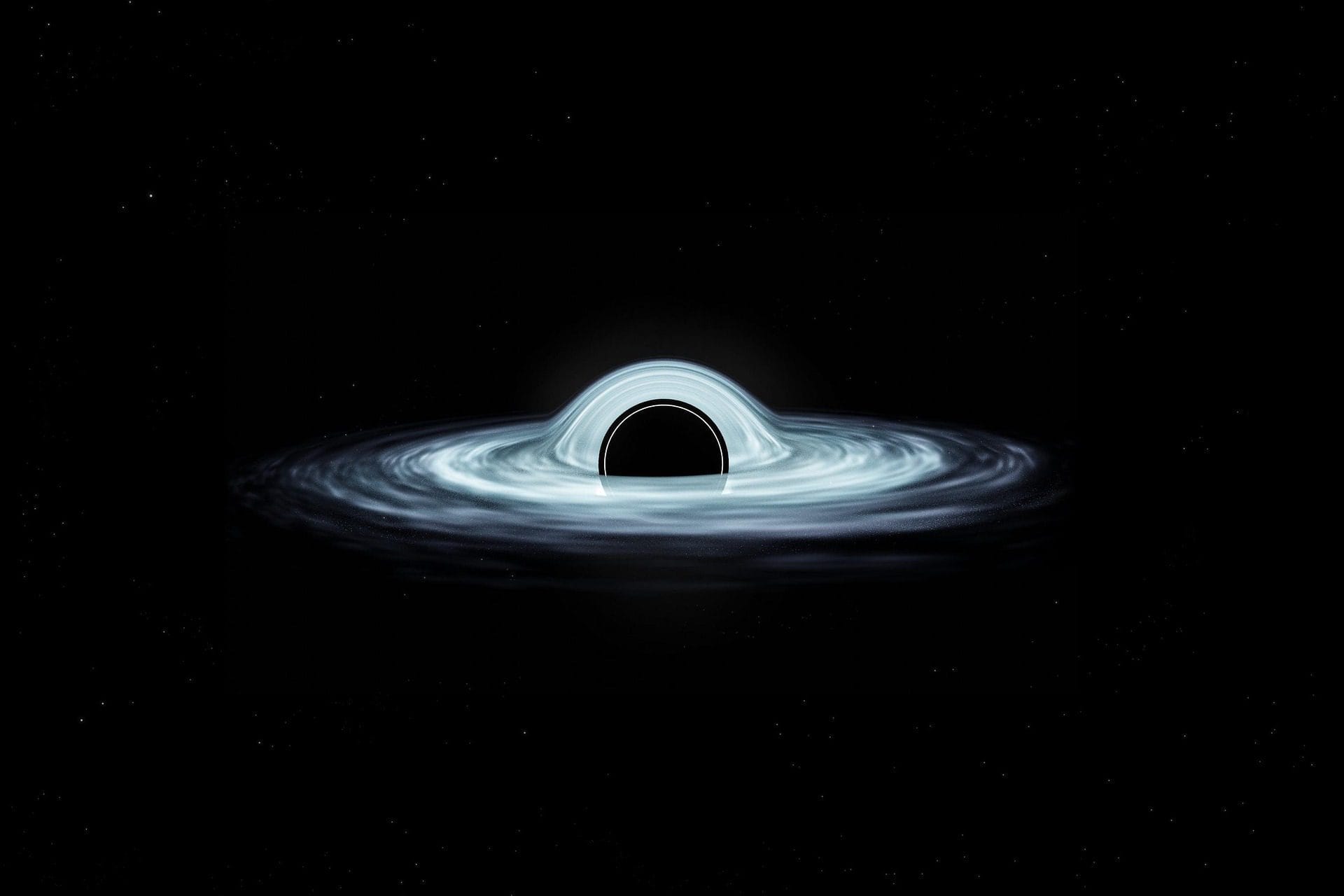
A black hole itself doesn’t have a glowing surface. The spectacular rings commonly seen in illustrations usually represent material surrounding it.
Gas and dust falling toward an active black hole can form a rotating structure known as an accretion disk. As this material races around the black hole, it becomes extremely hot and can release enormous amounts of radiation.
That creates one of astronomy’s great contradictions.
“An object defined by darkness can power some of the brightest environments in the universe.”
Space is full of environments that push matter to astonishing extremes—from these superheated regions to the coldest place in the universe, where temperatures approach the limits allowed by physics.
Closer in, gravity dramatically bends the paths of light. Some photons may curve around the black hole before escaping, while others disappear forever. Eventually, our imaginary journey reaches a boundary unlike anything in everyday life. The event horizon.
The Event Horizon: Where Escape Becomes Impossible
This event horizon sounds like a physical surface. It isn’t.
You wouldn’t crash into a wall. There would be no glowing barrier floating in space or cosmic warning sign announcing that you’ve reached the point of no return. Instead, the event horizon is a boundary in spacetime.
For a simple, non-rotating black hole, its location is described by the Schwarzschild radius:
rₛ = 2GM/c²
G = the gravitational constant
M = the black hole’s mass
c = the speed of light
The equation tells us something important: a more massive black hole has a larger event horizon. Cross that boundary, however, and the consequences are absolute.
No rocket could bring you back. Even a beam of light aimed outward couldn’t escape. To return to the outside universe, you would need to violate the causal structure described by general relativity. Strangely enough, crossing this ultimate boundary might feel surprisingly uneventful.
What Would Someone Watching You Fall See?
Suppose you’re falling toward the black hole while a friend watches from a safe distance. From their perspective, your journey becomes increasingly strange.
As you approach the event horizon, the light coming from you becomes more strongly redshifted. Its wavelength stretches toward the red end of the spectrum and eventually beyond visible light.
At the same time, you appear increasingly dim. Your motion also seems to slow as you approach the horizon.
Eventually, you effectively fade from view. Your friend never receives a final image showing you crossing the event horizon and casually waving goodbye from the other side.
Your experience, however, is very different.
What Would You Experience?
Your watch keeps ticking. And your heart keeps beating. Nothing locally tells you that time has suddenly stopped.
If the black hole is sufficiently massive and the surrounding environment isn’t already lethal, you could cross the event horizon without encountering a physical surface.
There might be no dramatic moment at all. One second you’re outside. Then you’re inside. And you’ve just crossed a boundary from which no message you send can ever reach the distant universe.
That difference between your experience and the distant observer’s view is one of the strangest consequences of Einstein’s theory of general relativity.
Would Time Stop Inside a Black Hole?
No—not according to your own clock. This is where black-hole explanations sometimes become misleading.
Strong gravity affects how clocks at different locations compare with one another. This effect is known as gravitational time dilation.
To someone observing from far away, your signals become increasingly delayed and redshifted as you approach the horizon. From your perspective, though, time continues normally.
Another popular claim goes even further: “Fall into a black hole and you’ll watch the entire future of the universe flash before your eyes.”
It sounds incredible. Unfortunately, it’s an exaggeration.
Light from the outside universe could appear heavily distorted. Gravitational lensing would warp your view, while incoming radiation could shift in frequency and direction.
An ordinary fall through an event horizon doesn’t simply give you an infinite fast-forward view of cosmic history. There is, however, something much worse waiting farther down.
Spaghettification: When Gravity Starts Pulling You Apart
Imagine you’re falling feet-first. Your feet are slightly closer to the black hole than your head. That difference matters.
Because gravity becomes stronger closer to the black hole, your feet experience a stronger pull than your head. At first, the difference may be small. As you fall deeper, it grows dramatically.
This growing difference in gravitational pull creates extreme tidal forces, stretching an object more and more as it falls toward the black hole. Physicists gave this horrifying process an unexpectedly funny name: spaghettification.
Yes, that’s really what it’s called. Eventually, tidal forces can become strong enough to tear a human body apart. Deeper still, matter would experience increasingly extreme conditions.
But here’s something surprising.
“Crossing the event horizon doesn’t always mean immediate spaghettification.”
The size of the black hole matters enormously.
Strangely, a Bigger Black Hole Could Be Gentler
This sounds completely backward. Surely a bigger black hole should tear you apart faster. Not necessarily—at least not at its event horizon.
A stellar-mass black hole has a relatively small horizon. Near that boundary, gravity can change dramatically over the distance between your head and feet. The resulting tidal forces can be devastating.
A supermassive black hole is different. Its event horizon can be enormous. Because of that larger scale, the difference in gravitational pull across your body at the horizon can actually be much smaller.
Under idealized conditions, you could therefore cross the event horizon of a sufficiently massive black hole without immediately being torn apart. For a brief moment, everything might seem fine. Unfortunately, you’ve now made a much bigger mistake. You’ve entered a region you cannot leave.
What Happens After You Cross the Event Horizon?
This is where everyday intuition begins to fail. Imagine turning your spacecraft around and firing the engines at maximum power. Nothing changes your ultimate fate. Point a laser outward and fire it. That doesn’t work either. Every future-directed path available to you leads farther inward.
One way to understand this is to think about your relationship with tomorrow. You can choose whether to travel north, south, east, or west. What you can’t do is decide to stop moving toward your future.
Inside the event horizon of an idealized non-rotating black hole, moving toward a smaller radius becomes similarly unavoidable. The center is no longer simply another place you could steer around.
“It’s in your future.”
Eventually, classical general relativity takes us toward the strangest part of the story. The singularity.
What Is Really at the Center of a Black Hole?
You’ve probably heard the standard answer:
“An infinitely dense point called a singularity.”
That’s useful as an introduction, but reality may be more complicated.
Classical general relativity predicts singular behavior deep inside an idealized black hole. Quantities such as spacetime curvature become unbounded in the mathematical description.
Does that mean nature literally contains a point of infinite density?
Not necessarily. In physics, an infinity can be a warning. It may indicate that a theory is being pushed beyond the conditions where it can provide a complete description.
That’s particularly important here because general relativity isn’t our only fundamental theory.
This Is Where Two Great Theories Collide
General relativity is remarkably successful at explaining gravity and the large-scale structure of spacetime.
Quantum mechanics is equally remarkable at describing particles and nature at extremely small scales.
Usually, physicists can work with these theories in their respective domains. Deep inside a black hole, that separation becomes much harder.
The extreme conditions near the region predicted to contain a singularity likely require gravity and quantum physics to be understood together. And that’s a problem.
Physics still doesn’t have a complete, experimentally verified theory of quantum gravity. Researchers have promising ideas. String theory, loop quantum gravity, holographic approaches, and other frameworks all explore parts of this enormous puzzle.
Some models even suggest that quantum effects could replace the classical singularity with something entirely different.
Fascinating? Absolutely.
Proven? No.
So, if someone asks what really exists at the deepest point inside a black hole, there’s only one scientifically responsible answer:
“We don’t know yet.”
That isn’t a failure of science. It’s the edge of the map.
Could a Black Hole Actually Be a Wormhole?
Now we’re entering territory where real physics and science fiction love to meet.
Could you fall into a black hole and emerge somewhere else? Another galaxy or another time? Perhaps even another universe?
The idea isn’t completely invented. Certain mathematical solutions to Einstein’s equations contain structures resembling bridges between different regions of spacetime. This helped inspire the concept known as an Einstein–Rosen bridge.
You probably know the more familiar name: wormhole.
However, there is no observational evidence that ordinary astrophysical black holes are traversable wormholes. Theoretical wormholes also create major problems. Many would be unstable or impossible to cross. Traversable versions often require unusual physical conditions that haven’t been demonstrated on the necessary scale.
So, could you use a black hole as a shortcut across the universe? Current evidence gives us no reason to think so. It remains a wonderful science-fiction idea—and an interesting theoretical question.
Could Another Universe Exist Inside?
Here’s where things become even more speculative. Some theoretical models have explored connections between black holes and new regions of spacetime. Ideas involving “baby universes,” white holes, and other exotic possibilities have appeared in theoretical research.
They’re fascinating to think about. Still, there’s an important distinction:
“Mathematically interesting doesn’t mean physically confirmed.”
No observation has shown that real black holes contain other universes or provide gateways to them. For now, those possibilities remain on the speculative side of physics.
Black holes are only one part of a much larger cosmic mystery. Questions such as The Great Filter push that uncertainty even further by asking why, in such an enormous universe, we still haven’t found convincing evidence of another technological civilization. One of the biggest involves something seemingly simple: information.
The Black Hole Information Paradox
Imagine throwing a book into a black hole. The book disappears beyond the event horizon. Clearly, you’re not getting it back. But quantum physics asks a deeper question.
What happens to the fundamental information describing everything that made up that book?
Quantum mechanics strongly suggests that information shouldn’t simply vanish from reality. Black holes seemed to create a problem for that idea. Then Stephen Hawking made the puzzle even stranger.
Hawking Radiation: Black Holes Don’t Last Forever
In the 1970s, physicist Stephen Hawking showed theoretically that quantum effects associated with black holes imply something remarkable. Black holes should have a temperature.
As a result, they should emit what became known as Hawking radiation. That means an isolated black hole can gradually lose energy and mass. For a simple black hole, its temperature is inversely related to its mass:
T ∝ 1/M
In other words, smaller black holes are hotter. Larger ones are colder.
For the astrophysical black holes in today’s universe, Hawking radiation would be extraordinarily weak. Their evaporation would also take unimaginably long periods—far longer than the universe has existed so far.
Still, the idea creates a profound question. Suppose matter falls into a black hole. Then imagine waiting until that black hole eventually evaporates. Where did the information go?
If it vanished completely, fundamental principles of quantum mechanics would be in trouble. But if that survived, how was it preserved & how could that information ultimately be represented in the radiation?
This puzzle became known as the black hole information paradox.
Modern theoretical research has produced powerful clues that information should ultimately be preserved. However, the complete microscopic story remains an active area of research.
There’s a Giant Black Hole in Our Own Galaxy
Black holes can sound incredibly distant. But there’s a supermassive one sitting at the heart of the Milky Way.
It’s called Sagittarius A*. Located roughly 27,000 light-years from Earth, Sgr A* contains about four million times the mass of the Sun.
Astronomers spent years following stars orbiting an apparently empty region near the center of our galaxy. Those stars were moving extraordinarily fast. Their paths revealed an enormous amount of mass packed into an incredibly small region.
The best explanation was a supermassive black hole. Today, astronomers can study that environment with astonishing precision.
In 2026, observations using the European Southern Observatory’s Very Large Telescope Interferometer reported an exceptionally fast star called S301 orbiting close to Sagittarius A*.
Near its fastest point, the star reaches roughly 25,000 kilometers per second—more than 8% of the speed of light. Watching stars race through environments like this gives astronomers a natural laboratory for testing gravity under extreme conditions.
Yes, we’ve even “photographed” black holes.
You’ve almost certainly seen it. A glowing orange ring surrounding a dark center. In 2019, the Event Horizon Telescope collaboration revealed the first horizon-scale image of the black hole at the center of galaxy M87.
Then came something much closer to home. In 2022, the collaboration released an image of Sagittarius A*.
But calling these pictures “photos of black holes” needs a little explanation. Light cannot escape from inside the event horizon. So the glowing material in those images isn’t coming from inside the black hole.
Instead, telescopes detect radiation from hot material around it. The black hole’s enormous gravity bends that light, helping create the distinctive ring-like appearance.
At the center lies a dark region known as the black hole’s shadow. In a sense, we’re seeing the black hole because of what we can’t see. And that’s rather beautiful.
Do Black Holes Suck Everything Into Them?
Thankfully, no. This is probably the most persistent black-hole myth. Imagine something impossible for a moment. Suppose the Sun instantly became a black hole while keeping exactly the same mass. Would Earth suddenly get sucked into it?
No. Our planet would continue following essentially the same orbit because the gravitational mass at the center of the solar system hadn’t changed. Of course, Earth would suddenly have a rather serious sunlight problem.
The important point is that black holes aren’t cosmic vacuum cleaners. They’re dangerous when you get close. And some unfortunate stars discover that in spectacular fashion.
Black Holes Can Tear Entire Stars Apart
A star passing too close to a massive black hole can experience enormous tidal forces. Eventually, gravity may overwhelm the star’s ability to hold itself together. The star gets torn apart. Astronomers call this a tidal disruption event.
Some of the destroyed material can begin swirling around the black hole. As it heats up, it may release a brilliant burst of radiation. That gives astronomers an opportunity. The black hole itself remains dark, but its unfortunate victim becomes a cosmic spotlight revealing where the black hole is hiding.
How Do Scientists Find Something That Doesn’t Emit Light?
Astronomers have become remarkably good at finding invisible objects. One method involves watching stars orbit something that can’t be seen directly. This approach played a major role in revealing Sagittarius A*.
Hot material provides another clue. Gas falling toward a black hole can reach extreme temperatures and release powerful radiation, including X-rays.
Gravity itself can also reveal the black hole’s presence by bending light from more distant objects.
Then there are gravitational waves. When two black holes spiral together and merge, they disturb spacetime itself. Those disturbances travel outward as gravitational waves.
Observatories such as LIGO and Virgo have detected gravitational waves from merging black holes, allowing astronomers to study these collisions without relying on ordinary light. Suddenly, astronomers weren’t only looking at the universe. They were effectively listening to spacetime shake.
Space can reveal itself in equally strange ways, which is why phenomena such as the scariest sounds ever recorded in space are really scientific translations of signals our ears could never hear directly.
Finally, there’s the Event Horizon Telescope. By combining radio observatories spread across our planet, the project achieves extraordinary resolving power. Objects once considered almost impossible to observe have become something astronomers can study through their effects on nearby matter, light, and spacetime.
What Do We Know—and What Remains a Mystery?
Black holes aren’t entirely mysterious. A remarkable amount is now supported by observations.
Astronomers have strong evidence that black holes exist. Stellar-mass examples can form through stellar collapse, while accretion and mergers allow black holes to grow. Their gravity bends light and influences surrounding stars. When two black holes collide, the merger can send gravitational waves rippling through spacetime.
Meanwhile, matter outside an actively feeding black hole can become hot enough to produce intense radiation. Supermassive examples occupy the centers of many large galaxies, including our own. Horizon-scale observations have even revealed the environments surrounding M87* and Sagittarius A*.
Then we reach the boundary between observation and uncertainty. The true physical nature of the deepest black-hole interior remains unknown. No complete theory of quantum gravity has yet been experimentally established, and the classical singularity may not represent the final physical description.
The information paradox presents another unfinished problem. Although modern theoretical work offers important clues, physicists are still exploring its deepest implications.
As for wormholes and other universes? They’re fascinating possibilities, but observations have not shown that real astrophysical black holes provide either. That’s what makes the subject so compelling.
Black holes aren’t mysterious because scientists know nothing about them. They’re mysterious because we’ve learned enough to discover exactly where our current understanding begins to fail.
The Greatest Mystery Is Still Hidden Inside
A century ago, black holes existed mainly as strange possibilities emerging from equations. Today, they are observable parts of our universe.
Astronomers have tracked stars racing around invisible gravitational giants, captured the shadows of supermassive black holes, and detected ripples in spacetime created when two of them collide. Each discovery has transformed something once almost entirely theoretical into measurable science. Yet the event horizon still hides the answer to the most intriguing question.
“What actually happens inside?”
General relativity gives us a remarkable picture of the journey inward. It explains the event horizon, predicts extreme tidal forces, and describes how spacetime behaves under enormous gravity. Deeper inside, however, the theory eventually reaches conditions it cannot fully explain. That’s where one of physics’ greatest unfinished stories begins.
A successful theory of quantum gravity could completely change our picture of the black-hole interior. The classical singularity might turn out to be something very different, while the information paradox may reveal unexpected clues about the fundamental nature of spacetime itself.
Whatever the eventual answer looks like, black holes have already taught us something profound: the universe can create environments so extreme that our most successful theories are pushed to their limits. Perhaps that’s what makes them so captivating.
Every observation brings the darkness into slightly sharper focus, yet the deepest secret remains beyond our view.
“Somewhere past the event horizon lies a part of the universe that physics has not fully explained yet—and understanding it could change how we think about space, time, and reality itself.”
F.A.Q.
After crossing the event horizon, light from the surrounding universe could appear heavily distorted by extreme gravity. However, no observer has ever seen the inside of a black hole, so our understanding comes from general relativity and theoretical physics rather than direct observation.
It depends heavily on the black hole's mass and your trajectory. Near a smaller stellar-mass black hole, extreme tidal forces could become deadly before or around the event horizon. A supermassive black hole could allow you to cross the horizon before those forces became catastrophic.
Once matter crosses the event horizon, it can no longer communicate with the outside universe. General relativity predicts that it continues inward, but exactly what ultimately happens under the extreme conditions of the deepest interior remains unresolved.
Not necessarily from the perspective of someone falling inward. Light entering from outside could still reach an infalling observer under certain conditions. However, once inside the event horizon, that light—and the observer—cannot return information to the external universe.
Yes. Two black holes can orbit one another, spiral inward, and eventually merge into a larger black hole. These collisions release enormous amounts of energy through gravitational waves, which observatories such as LIGO can detect across vast cosmic distances.
According to Hawking's theoretical prediction, an isolated black hole can lose mass extremely slowly through Hawking radiation. If it eventually evaporated completely, the final stages would involve physics that remains difficult to describe with our current theories. Understanding what happens to the information associated with everything that entered the black hole is part of the black hole information paradox.