Do you ever wish you could go back and correct a mistake? Or fast-forward a few decades and see what the world is like in the future? People just like you exist. The concept of time travel has intrigued people for many generations. That’s why tales of time machines, alternate timelines, and futuristic adventures never fail to capture our imagination. But time travel, the staple of science fiction, also poses a serious question:
Could time travel ever be possible?
It’s an answer that might surprise most people. In modern physics, the future is not just a fantasy; it has already happened, albeit in small but measurable ways. But going into the past is where things get a lot more complicated.
So let’s travel through the science of time travel and see what the researchers really think.
Time Is Stranger Than You Think
For the majority of us, time is a constant. Seconds go by, minutes go by, and everyone passes through them at the same speed. But that is not how the universe works.
In the early 1900s, Albert Einstein revolutionized our understanding of time. His theories showed that time is not an all-time clock that ticks away the same for all. But instead of slowing down, speeding up and acting differently, depending on your situation.
Einstein’s work gave us one of the most famous equations in history:
$$
E = mc^2
$$
This equation is often associated with energy and mass, but Einstein’s wider theories revealed something just as astonishing.
Time is malleable.
And the flexibility that is allowed makes time travel possible.
Traveling Into the Future Is Already Real
When people hear “time travel,” they often imagine a machine with flashing lights and complicated controls. The reality is much less dramatic—but scientifically proven.
According to Einstein’s theory of relativity, time passes more slowly for objects moving at extremely high speeds. This phenomenon is known as time dilation.
Imagine two twins. One stays on Earth while the other boards a spacecraft capable of traveling close to the speed of light. After several years, the traveler returns home.
What will happen?
The older twin is the one who stays on Earth. The traveler has been away only a few years, but the Earth has seen many more. In a way, that traveler has jumped to the future.
And it’s not just theory. Scientists have measured time dilation using very accurate atomic clocks. The clocks on fast-moving planes and on satellites tick just a little bit differently than the clocks on Earth. Modern GPS systems also have to take these tiny differences into account. Without those fixes your navigation apps would quickly become useless.
So while we can’t leap centuries ahead at the push of a button, physics tells us that traveling into the future is absolutely possible.
Gravity Also Can Slow Time
Speed is not only a function of time. Gravity does that, too.
Einstein’s general relativity was a theory that showed that large masses bend space and time. The stronger the gravitational field, the slower is the passage of time.
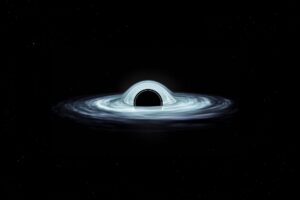
On Earth this effect is tiny, but it becomes dramatic near incredibly dense objects such as black holes. Read what happens near a black hole for more information.
Now imagine yourself near a supermassive black hole and a friend far away in space. If you could survive the extreme conditions, time would pass much slower for you. A few hours near a black hole might be years elsewhere.
The idea was popularized by Interstellar, where astronauts experienced big time differences because of intense gravity. The movie might have been fiction, but the science behind that concept was very real.
Wormholes: The Universe’s Short Cut?
But if traveling to the future seems possible, what about going to the past? This is where wormholes come into the conversation.
A wormhole is a hypothetical tunnel linking two separate points in space-time. Consider folding a piece of paper so that two distant points coincide. But instead of going down the length of the sheet, you could just go down the fold.
That’s the basic concept behind a wormhole. Theoretical models have suggested that if wormholes exist and could be stabilized, they could allow travel between times.
That sounds great, doesn’t it?
The only problem is nobody has ever found a wormhole. Even worse, maintaining one may require exotic forms of matter with unusual properties that we don’t know how to create or control.
For now, wormholes are a tantalizing possibility, but not a working technology.
The Problem With Changing History
Just suppose that time travel backwards is actually possible. Immediately a big problem presents itself.
What if you alter history?
This question has inspired one of the most famous thought experiments in science, the Grandfather Paradox.
What if you could travel back in time and stop your grandparents from meeting in the first place?
If they never met, your parents wouldn’t be. If you had no parents, you wouldn’t exist either. But if you were never born, who was the one who went back in time to interfere in the first place?
The logic is not consistent. Paradoxes like these are one reason many scientists are still skeptical about backward time travel.
How Could Paradoxes Be Avoided?
Scientists suggest a range of potential solutions.
The Past Cannot be changed
One idea is that you can’t change events in the past. You can go back and check history, but whatever you do is history. No matter what you did, things would happen just the same as they always did.
There Are Alternate Timelines
Another possibility follows from some interpretations of quantum mechanics. In this case, changing the past doesn’t change your original timeline. Rather, it creates a new branch of reality.
You could save a historical figure or stop a major event, but you’d just be creating an alternate universe instead of rewriting your own history.
Nature Stops Time Travel
Some physicists think the universe may have natural rules that would prevent time travel to the past. In other words, the laws of physics may prevent cause and effect from ever being broken.
What quantum physics is telling us?
Quantum physics often seems more bizarre than science fiction. Particles can be weird, seem to be connected across huge distances, and go against our everyday experience of reality.
The smallest scales of nature are governed by quantum mechanics, and so some researchers suspect it may contain clues about the true nature of time. The issue is that physicists still don’t have a full theory that successfully combines gravity and quantum mechanics.
And many questions about time travel remain unanswered until that puzzle is solved.
Biggest Challenges
Even if time travel is theoretically possible, turning it into a reality would be a huge challenge. Scientists would have to overcome hurdles like these:
- Vast energy requirements
- Extreme gravitational conditions
- The absence of known wormholes
- Potential instability in spacetime
- Unresolved paradoxes and causality issues
These aren’t small engineering problems; these are some of the biggest scientific problems you can imagine.
So, will humans ever travel through time?
The honest answer is nobody knows. What we do know is interesting enough. Physics has already proven that time is not absolute. It can stretch, it can slow, and it can act differently at different speeds and gravities.
That means one means of time travel, into the future, is backed up by both theory and experiment.
But time travel to the past remains pure speculation. We may discover things in the future that make us think about the universe in ways we can’t even think about now. After all, many scientific breakthroughs looked impossible until the evidence proved otherwise.
Conclusion
Time travel is a matter that straddles science and imagination. Einstein’s discoveries revealed that time is far more elastic than common sense would indicate. Experiments show that time flows at a different rate if you travel very quickly or if you are in a strong gravitational field.
In a very real sense, the future is already here.
The past, however, still keeps its secrets.
Whether humanity ever develops the technologies that can warp spacetime or discovers completely new laws of physics, one thing is guaranteed: the puzzle of time travel will continue to be a source of curiosity, discussion, and awe for generations to come.
If ever there comes a time when time travel is possible, then perhaps the first visitor from the future is yet to come, or perhaps they are already here.