
Space is often called silent. Well, that’s only partly true. On Earth, sound waves can’t travel through the vacuum of space, but NASA and other space agencies have found something deeply unsettling: electromagnetic waves, plasma vibrations, and radio emissions can be converted into audio that humans can hear. The results are cold shivers.
Some of the spookiest sounds ever “heard” have come from space itself—from ghostly whistles bouncing around Earth’s magnetic field to eerie plasma waves captured outside the solar system.
Why Space Sounds So Creepy
In theory an astronaut floating in the vacuum of space would hear nothing. There is virtually no air to carry sound waves. But spacecraft instruments can detect electromagnetic vibrations, radio emissions, and plasma oscillations. Then scientists translate those signals into audible frequencies in a process called sonification.
The strange result sounds less like science and more like the soundtrack to a horror film.
NASA missions have yielded some of the most disturbing recordings ever made available to the public, such as Voyager 1 and the Van Allen Probes.
1. Voyager 1’s Interstellar “Screams”
In 2012, Voyager 1 became the first human-made object to enter interstellar space. As it crossed beyond the heliosphere, its plasma wave instrument detected vibrations from ionized gas drifting between stars. NASA later converted those signals into audio.
The sound? A rising, eerie howl that many listeners compare to a distant sci-fi alarm or ghostly scream.
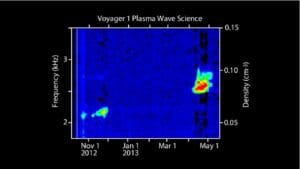
NASA explained that the spacecraft recorded plasma oscillations between October and November 2012 and again in 2013. Scientists noticed a steadily rising tone, indicating denser interstellar plasma beyond the solar system.
One of the creepiest parts is that these frequencies naturally fall within the range of human hearing. NASA scientists simply amplified them.
What caused the sound?
- Charged particles vibrating in interstellar plasma
- Shockwaves from solar eruptions
- Plasma density changes beyond the heliopause
2. The “Chorus Waves” Around Earth
NASA’s Van Allen Probes recorded strange electromagnetic waves surrounding Earth called chorus waves.
When converted into sound, they resemble the following:
- Birds chirping in darkness
- Metallic screeches
- Alien communication signals
Scientists say these waves are generated when electrons interact with Earth’s magnetic field.
Some recordings become even more disturbing when slowed down, sounding like whispers echoing through an abandoned structure.
NASA researchers study these sounds because the waves can damage satellites and affect communications systems during solar storms.
3. Jupiter’s Radio Emissions
The planet Jupiter produces powerful radio emissions generated by its enormous magnetic field.
NASA spacecraft detected:
- High-pitched shrieks
- Rhythmic crackling
- Deep cosmic humming
These emissions are partly caused by charged particles interacting with Jupiter’s magnetosphere and volcanic material from its moon Io.
Many listeners describe the recordings as sounding “alive.”
NASA also detected “whistler” waves near Jupiter—similar to eerie, descending tones heard around Earth.
4. The Black Hole Sound That Terrified the Internet
In 2022, NASA released a sonification of pressure waves coming from the black hole at the center of the Perseus galaxy cluster. The recording quickly went viral because of its horrifying, almost supernatural tone.
Although the actual frequencies were far too low for humans to hear, NASA shifted them upward by dozens of octaves. The result sounded like
- A cosmic moan
- A deep mechanical growl
- A horror-film ambience
Online reactions described it as “nightmare fuel.”
Scientists clarified that this was not traditional sound traveling through empty space. Instead, the waves moved through hot gas surrounding the black hole.
5. Solar Wind “Music” from the Sun
NASA’s Parker Solar Probe recorded fluctuations inside the solar wind — streams of charged particles flowing from the Sun.
After converting the plasma data into sound, researchers produced an unsettling audio clip resembling the following:
- Distorted static
- Electrical buzzing
- Sci-fi reactor noise
The recordings came from within the Sun’s outer atmosphere, making them among the closest “sounds” ever captured near a star.
How NASA Turns Space Data into Audio
The process is called data sonification.
Instead of recording air vibrations, spacecraft detect the following:
- Plasma waves
- Radio emissions
- Magnetic field oscillations
- Electromagnetic activity
Scientists then convert those signals into frequencies humans can hear.
This technique helps researchers identify patterns that may be harder to spot visually.
Are These Sounds Real?
Yes — but with an important caveat.
The sounds are not recorded by microphones floating in empty space. Instead:
- Instruments detect electromagnetic or plasma activity.
- Computers translate the data into audio frequencies.
- Humans can then “listen” to space phenomena.
So while the sounds are scientifically authentic, they are transformed representations of cosmic activity rather than ordinary sound waves.
Why People Are Fascinated by These Cosmic Sounds
Humans are naturally sensitive to strange sounds. Deep drones, distorted frequencies, and unnatural tones invoke fear because our brains connect them to danger or the unknown.
That’s why space audio is so unsettling:
- It’s not known
- It’s a lonely feeling.
- It reminds us how alien the universe really is.
NASA’s spooky recordings show that the universe is not a silent place, but rather a cosmos filled with invisible vibrations, plasma storms, and electromagnetic “music” reverberating through the darkness.
Conclusion
The creepiest sounds ever captured in space aren’t just internet oddities. They are scientific windows on unseen cosmic phenomena—from interstellar plasma outside the solar system to magnetic storms around planets and black holes.
And perhaps the most disturbing part is this
They were always present. It is only lately that man has learned how to hear them.
You can read more from NASA about this.