
Have you ever wondered what it would feel like to walk through a city that was once full of life—only to find it completely abandoned?
Imagine crowded markets, busy streets, powerful rulers, religious ceremonies, and thousands of people going about their daily lives. Then, over time, the city becomes quieter.
Buildings are left unfinished. Temples are no longer maintained. Streets that once carried crowds slowly disappear beneath dust, plants, and soil. Eventually, an entire city becomes a ruin.
Thousands of years later, archaeologists discover it and ask the question that has fascinated people for generations:
“Where did everyone go?”
This is the mystery behind some of the world’s most fascinating ancient civilizations.
From the Maya cities hidden deep in the jungles of Central America to the enormous urban center of Cahokia in North America, history is filled with lost knowledge of the ancient world and civilizations that appear to have simply disappeared. But there is one important detail we often forget.
Most ancient civilizations did not actually vanish overnight.
In many cases, cities declined over decades or even centuries. People migrated. Governments weakened. Trade routes changed. Climate conditions became more difficult.
And sometimes, a civilization did not disappear at all. It simply changed into something different.
What Does It Really Mean When a Civilization “Disappears”?
When we hear the words “lost civilization,” it’s easy to imagine an entire population mysteriously disappearing without leaving a trace.
But archaeology usually tells a more complicated story. A civilization may be described as “lost” when:
- Its major cities are abandoned
- Its government loses power
- Monument building stops
- Its writing system is no longer used
- Trade networks collapse
- People migrate to other regions
- Its culture becomes part of a new society
The important thing to understand is that the disappearance of a city does not necessarily mean the disappearance of its people. A city can collapse while its population survives elsewhere.
This is exactly what happened with one of the most famous civilizations in history: the Maya.
1. The Maya: The Civilization That Never Truly Disappeared
Few ancient civilizations have inspired as many mysteries as the Maya. The Maya built enormous cities, created sophisticated calendars, developed advanced mathematics, recorded history through hieroglyphic writing, and constructed incredible temples and pyramids.
At their height, Maya civilization was one of the most advanced societies in the ancient Americas. Between roughly 250 and 900 CE, many Maya city-states flourished across parts of modern-day Mexico, Guatemala, Belize, Honduras, and El Salvador.
Cities such as Tikal, Calakmul, Copán, and Palenque were powerful centers of politics, religion, trade, and culture.
Then something began to change. During the eighth and ninth centuries, many major cities in the southern Maya lowlands began to decline. Royal monuments became less common. Political power weakened. Some cities were eventually abandoned.
To someone looking at the ruins centuries later, it might appear as if an entire civilization simply vanished. But the reality was far more complicated.
Why Did the Maya Cities Decline?
There probably wasn’t one single cause. Instead, several problems may have happened at the same time.
One major factor appears to have been drought.
Research suggests that prolonged periods of drought affected parts of the Maya region. When rainfall decreased for long periods, agriculture and water supplies would have come under enormous pressure.
But drought alone probably doesn’t explain everything. The Maya also faced:
- Warfare between rival city-states
- Political instability
- Population pressure
- Agricultural challenges
- Deforestation
- Competition for resources
- Disrupted trade
Think about it this way. A society can probably survive one difficult problem. But what happens when several problems arrive at the same time?
A long drought can reduce food supplies. Food shortages can create social tension. Political leaders may struggle to maintain control. Rival cities may become more aggressive. And once people lose confidence in their leaders, a powerful kingdom can begin to fall apart. This may have been part of what happened to the Maya.
The Maya Did Not Disappear
This is one of the biggest misconceptions about Maya history. The Maya people did not vanish.
Many major cities declined, but Maya communities continued to exist. Maya culture survived, evolved, and continues to this day. In fact, millions of Maya people still live across Mesoamerica. So the real story is not that the Maya mysteriously disappeared.
Instead, many of their great cities and political systems declined while Maya people continued to adapt and survive. In some ways, that story is even more fascinating.
2. The Indus Valley Civilization: When Great Cities Slowly Emptied
Thousands of years ago, one of the world’s earliest urban civilizations flourished across parts of modern-day Pakistan and northwestern India. This was the Indus Valley Civilization, also known as the Harappan Civilization.
Its cities were remarkably advanced for their time. They had:
- Carefully planned streets
- Sophisticated drainage systems
- Standardized bricks
- Organized urban layouts
- Long-distance trade networks
- Advanced systems of measurement
Cities such as Mohenjo-daro and Harappa were enormous urban centers by ancient standards. Then, over time, something changed.
The cities began to decline. There is no single dramatic event that clearly explains what happened. No universally accepted record describes one great invasion or one catastrophic disaster.
Instead, researchers believe that long-term environmental and climatic changes may have played an important role.
Some studies suggest that prolonged drought and changing rainfall patterns made life in some of the major cities increasingly difficult. Rather than suddenly disappearing, populations may have gradually moved toward areas with more reliable water supplies.
This creates a very different picture from the classic idea of a vanished civilization. Perhaps the people did not disappear. Perhaps the cities simply stopped being the best places to live.
As water availability changed, large urban centers may have become harder to support. People gradually moved to smaller communities. The great cities became quieter. Eventually, some were abandoned.
The civilization didn’t necessarily end in one dramatic moment. It may have slowly deurbanized. And that is something we often forget about history.
Sometimes civilizations do not collapse with explosions and battles. Sometimes they simply become less practical.
3. Cahokia: The Lost City of North America
When people imagine ancient civilizations, they often think of Egypt, Rome, Greece, or Mesopotamia. But one of the largest cities in ancient North America was located near present-day St. Louis. Its name was Cahokia.
At its height, Cahokia was a major urban and cultural center of the Mississippian civilization. The city contained enormous earthen mounds, large ceremonial areas, homes, trading networks, and a substantial population. For its time, Cahokia was an extraordinary city.
And then, over the centuries, it was largely abandoned. So what happened?
The answer is still debated. Researchers have suggested several possible explanations, including:
- Environmental changes
- Flooding
- Deforestation
- Resource pressure
- Political conflict
- Changes in trade
- Social instability
The most likely explanation may not be one single event. Instead, several pressures may have gradually made life in Cahokia more difficult.
This is a pattern we see repeatedly in history. Civilizations are often not destroyed by one problem. They become vulnerable when multiple problems begin to build on top of each other.
4. Angkor: When a Water System Became a Weakness
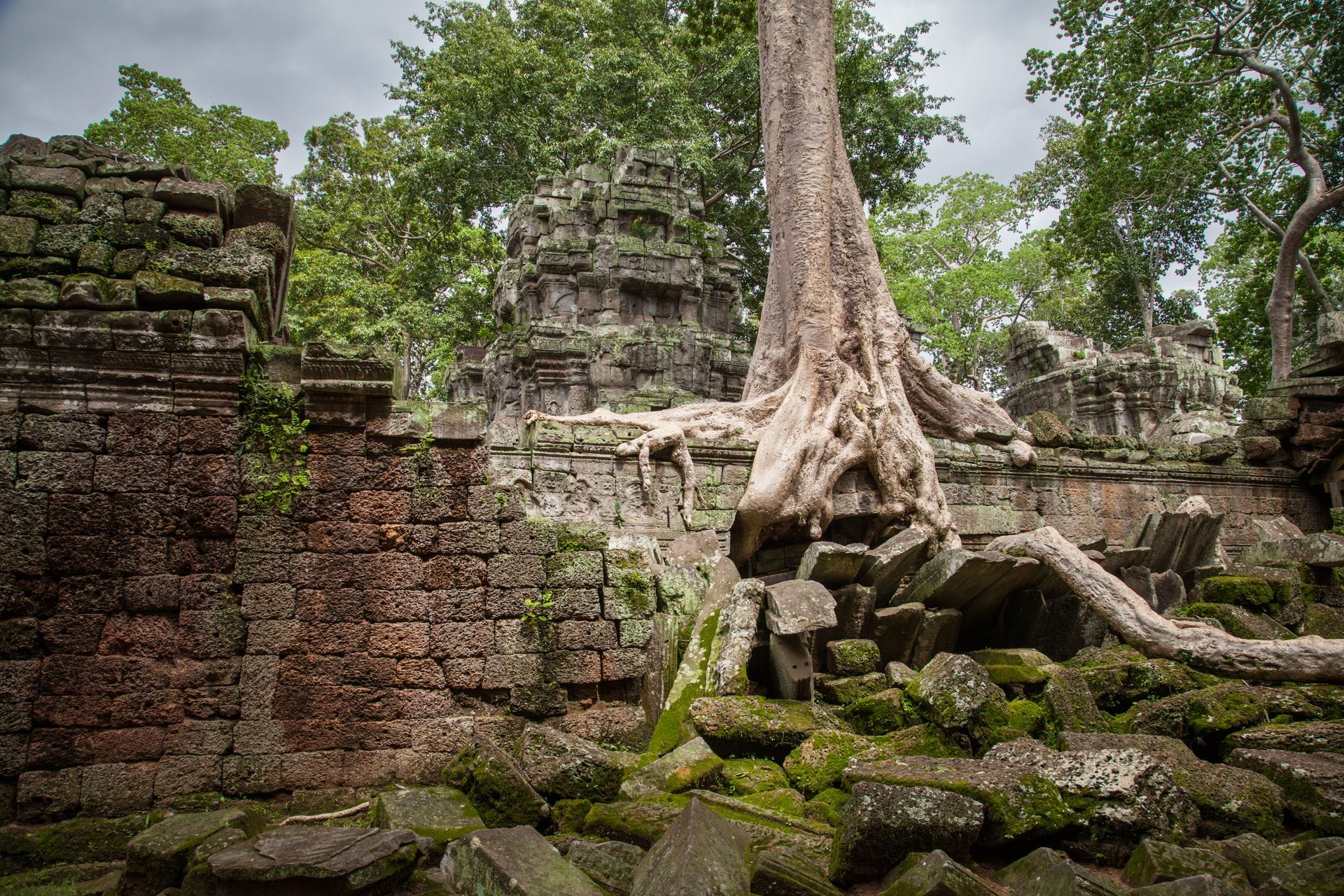
Deep in the forests of Cambodia stand the magnificent temples of Angkor. The most famous of them, Angkor Wat, has become one of the world’s most recognizable ancient monuments.
But Angkor was much more than a collection of temples. It was the center of the powerful Khmer Empire and supported a vast urban and agricultural system.
Water was absolutely essential to the city’s survival. The people of Angkor built an enormous network containing the following:
- Reservoirs
- Canals
- Embankments
- Water-control systems
- Agricultural infrastructure
This impressive network allowed the city to support a large population. But it may have also created a weakness.
Research suggests that periods of extreme climate variability—including severe droughts followed by intense rainfall—may have placed enormous stress on Angkor’s water-management systems.
A system designed to manage predictable seasonal patterns may struggle when the environment becomes unpredictable.
Over time, Angkor’s political importance declined. Power shifted elsewhere. The city was no longer the dominant center it had once been.
But once again, this was not a simple story of everyone suddenly disappearing. The region continued to be inhabited. The political center changed. The civilization transformed.
5. The Bronze Age Collapse: When the Ancient World Was Thrown Into Chaos
One of the most dramatic periods of collapse in ancient history occurred around the end of the Bronze Age. Around the late 13th and early 12th centuries BCE, several powerful civilizations across the eastern Mediterranean and Near East experienced enormous disruption.
Cities were destroyed. Palaces were abandoned. Trade networks collapsed. Kingdoms weakened or disappeared.
For a long time, historians searched for one simple explanation. Some blamed the mysterious group known as the Sea Peoples. Others pointed to:
- Earthquakes
- Warfare
- Drought
- Famine
- Rebellion
- Political instability
Today, many researchers believe the collapse was more complicated. The civilizations of the Bronze Age were deeply connected.
One kingdom might depend on another for metals. Another might rely on imported grain. A third might depend on stable trade routes. When one part of the system failed, the consequences could spread.
Imagine a chain reaction.
A drought reduces food production. Food shortages create unrest. Unrest weakens governments. Political instability disrupts trade. Trade disruptions create even more shortages. Eventually, several problems begin feeding into each other.
This may be what happened during the Bronze Age collapse. It may not have been one single disaster. It may have been a system-wide failure.
Why Do Civilizations Collapse?
When we study civilizations that appear to have vanished, the same major causes appear again and again.
1. Climate Change and Drought
Climate can have a powerful effect on human societies. A long drought can lead to the following:
- Failed harvests
- Water shortages
- Famine
- Migration
- Political instability
- Conflict
The Maya are a particularly important example of how drought may have contributed to a wider societal crisis. But it is important to remember that climate change alone does not automatically destroy a civilization.
The real danger often comes from the interaction between environmental problems and existing social weaknesses.
2. Environmental Pressure
Ancient civilizations depended heavily on their environment. If forests were cleared too quickly, soil could become damaged, or if land were farmed too intensely, agricultural productivity could decline. Also if water systems were poorly managed, the environment could become increasingly difficult to support.
A society can sometimes survive environmental damage for generations. But eventually, the pressure may become too much.
3. War and Political Conflict
Civilizations can also weaken from within. Rival rulers, civil wars, rebellions, and political struggles can gradually destroy the stability of a society.
When central authority weakens, regions may begin to break away. The civilization may fragment into smaller kingdoms or communities.
Sometimes, this process happens so gradually that people living through it may not even realize that the world they know is disappearing.
4. The Collapse of Trade
Ancient civilizations were often more interconnected than we realize. They depended on trade for:
- Metals
- Timber
- Food
- Luxury goods
- Building materials
If trade routes were disrupted, shortages could quickly spread. The Bronze Age Collapse is a powerful example of what can happen when interconnected systems suddenly stop working.
5. Disease and Population Decline
Disease may also have played a role in the decline of some ancient societies. Large cities naturally create conditions where disease can spread quickly. When disease is combined with famine, war, and poor living conditions, populations can decline rapidly.
However, evidence for ancient diseases is often limited, so researchers must be careful when drawing conclusions.
The Biggest Myth About “Lost Civilizations”
Perhaps the biggest misconception is that an ancient civilization must completely disappear for it to be considered “lost.” But history is rarely that simple.
People move. Cities decline. Governments collapse. Cultures mix. Languages change. New kingdoms rise over the ruins of old ones. The people themselves may continue living in the same region. The Maya are a perfect example. Their great cities declined, but Maya culture survived.
The same pattern appears in different forms across the ancient world. A civilization can lose its capital without losing its people. It can lose its political system without losing its culture. It can lose its cities without disappearing completely.
What Can Ancient Civilizations Teach Us Today?
This is perhaps the most interesting question of all. The problems faced by ancient societies may seem distant, but some of them sound surprisingly familiar. Ancient civilizations struggled with:
- Climate instability
- Resource shortages
- Political division
- Environmental damage
- Economic disruption
- Dependence on complex systems
Ancient societies also depended on complex systems just as modern society does. But modern society is obviously very different. We have technologies and systems that ancient civilizations could never have imagined. But a major disruption can sometimes create consequences far beyond the original problem for us also. What would happen if the modern world’s most important connected system suddenly failed?
But history still offers an important lesson. Societies rarely collapse because of one problem alone.
A drought may be manageable. Political conflict may be survivable. Economic problems may be temporary.
But when several crises happen at the same time, a society can become dangerously fragile. That may be one of the most important lessons hidden inside the ruins of ancient cities.
Conclusion
The idea of an ancient civilization disappearing overnight is incredibly powerful. It makes us imagine a mysterious event. One day, a city is full of life. Next, it is empty.
But the real story is often more complicated. The Maya did not disappear. The Indus Valley people may have gradually moved away from their major cities. Cahokia declined after centuries of growth and change. Angkor lost its political importance as the region transformed. The Bronze Age Collapse may have been caused by a chain reaction involving climate, war, political instability, and the breakdown of trade.
These civilizations did not simply vanish like ghosts. They changed, adapted, and migrated. They rebuilt their lives elsewhere. And in many cases, their descendants continued to live in the same regions for thousands of years.
Maybe the real mystery is not why civilizations disappear. Maybe the real mystery is how human beings continue to survive and adapt when the world around them begins to change.
F.A.Q.
No major ancient civilization is known to have literally disappeared overnight. Most civilizations that appear to have vanished declined gradually because of factors such as climate change, drought, warfare, political instability, migration, and economic disruption.
The decline of many Maya cities was probably caused by several factors, including prolonged drought, warfare, political instability, population pressure, and environmental stress. Drought appears to have been an important factor, but it was likely not the only cause.
No. The Maya people did not disappear. Although many major Classic Maya cities declined, Maya communities continued to exist, and Maya culture remains alive today.
The Indus Valley Civilization is often considered one of the most mysterious because many questions remain about its writing system, urban decline, and the reasons why its major cities were gradually abandoned.
Civilizations usually decline because of several connected factors rather than one single event. Common causes include climate change, drought, warfare, political instability, environmental damage, disease, economic disruption, and migration.