
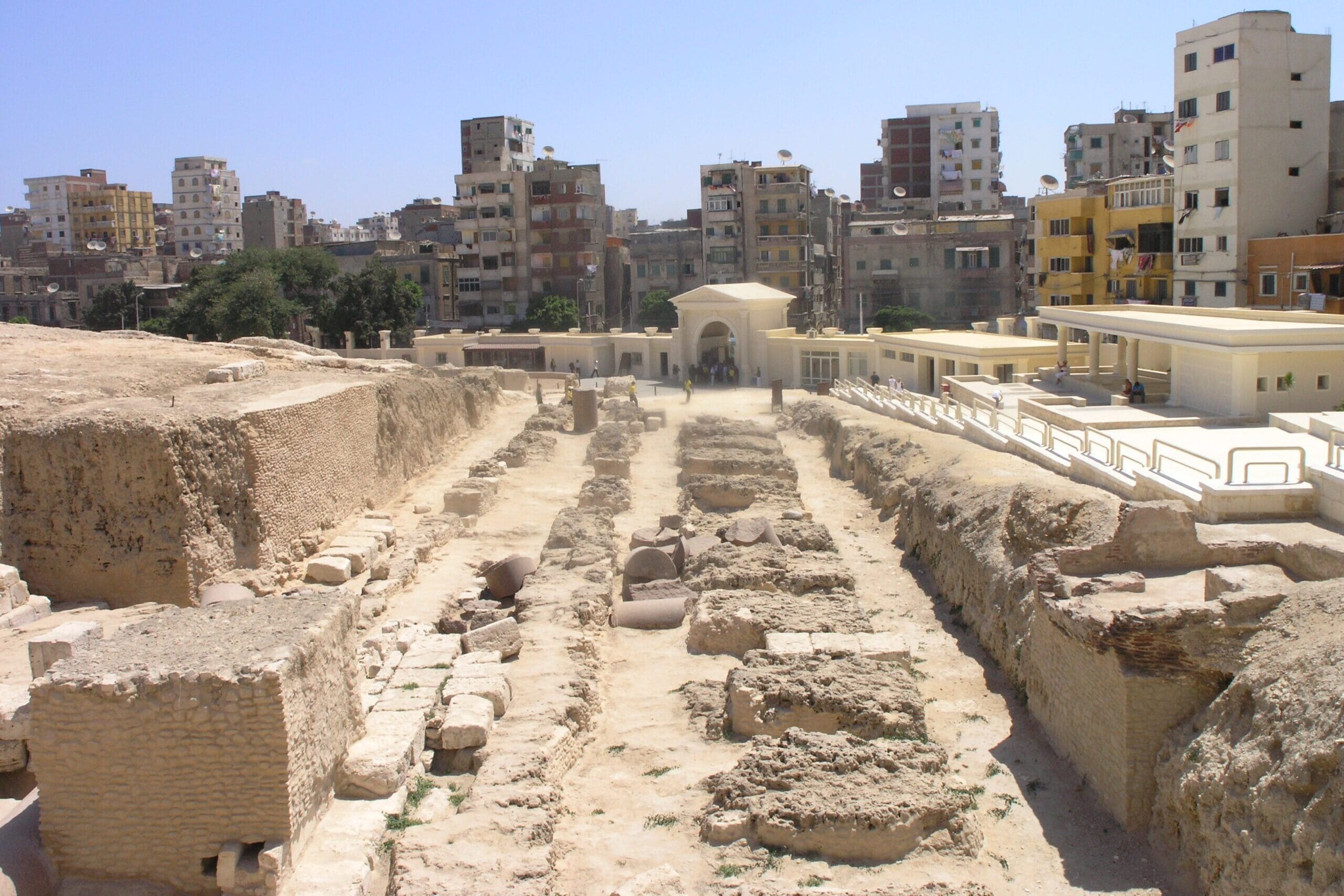
Imagine walking into a place where centuries of human thought surrounded you. Astronomy. Mathematics. Medicine. Philosophy. Geography. Poetry. History.
Thousands upon thousands of papyrus scrolls containing ideas gathered from across the ancient world—all brought together in one extraordinary center of learning. That was the ambition behind the legendary Library of Alexandria.
More than two thousand years later, however, its story has become tangled with a darker idea: that the library contained forbidden ancient knowledge—scientific discoveries, technologies, historical records, or secrets that disappeared when the institution was destroyed.
It is an irresistible mystery. But there is a problem. The popular image of one enormous library suddenly burning to the ground, taking the accumulated knowledge of the ancient world with it, is almost certainly too simple.
The real story of the Library of Alexandria is stranger, more complicated, and perhaps even more fascinating.
What Was the Library of Alexandria?
The Library of Alexandria emerged during the Ptolemaic period in Egypt, probably in the early third century BCE under Ptolemy II Philadelphus, although its intellectual foundations may have begun under his father, Ptolemy I Soter.
It formed part of a larger institution called the Mouseion, a center dedicated to scholarship and the Muses. Calling it simply a “library” can therefore be misleading.
The Mouseion functioned more like an ancient research institute. Scholars could study literature, mathematics, astronomy, medicine, geography, philosophy, and other subjects while working alongside some of the most accomplished intellectuals of their age.
The Ptolemaic rulers wanted Alexandria to become one of the great intellectual centers of the Mediterranean world. Books were essential to that ambition.
How Many Scrolls Did Alexandria Really Have?
This is where legend begins colliding with history. Ancient and later accounts provide enormous numbers for the collection, but historians cannot determine exactly how many individual works the library possessed.
Estimates have ranged from tens of thousands to several hundred thousand scrolls. There is another complication: one scroll did not necessarily equal one book in the modern sense. A lengthy work could occupy multiple papyrus rolls.
So claims that Alexandria contained 400,000 or 700,000 “books” should be treated cautiously. What matters more than the exact number is the scale of the project.
Alexandria attempted something extraordinary: gathering and organizing knowledge from across much of the known world in one scholarly center.
Alexandria Wanted the World’s Knowledge
The Ptolemies aggressively expanded their collections. According to an account preserved by the ancient physician Galen, books arriving aboard ships in Alexandria could be taken for copying. The originals were reportedly retained while copies were returned to their owners.
Agents were also sent abroad to acquire valuable texts. The resulting collection drew heavily from Greek intellectual traditions while existing within the culturally diverse world of Ptolemaic Egypt and the wider Mediterranean.
This made Alexandria much more than a warehouse filled with scrolls. It became a place where knowledge could be collected, compared, corrected, translated, organized, and expanded. And that environment produced remarkable scholarship.
The Minds That Made Alexandria Legendary
Some of antiquity’s most influential intellectual work became associated with Alexandria and its scholarly culture.
Eratosthenes, who became chief librarian, famously estimated Earth’s circumference using geometry and observations of shadows. His calculation demonstrated a remarkably sophisticated understanding of mathematics and the planet more than two millennia ago.
Callimachus created the Pinakes, a vast bibliographical catalog used to organize authors and works.
Alexandrian scholars also produced influential editions of classical literature and contributed to research in mathematics, astronomy, geography, anatomy, mechanics, and language.
This intellectual culture is one reason the library attracts so much speculation today. If the science we know about was already impressive, what existed in texts that did not survive?
Did the Library Contain “Forbidden Knowledge”?
This is where documented history needs to be separated from modern mythology. There is no reliable historical evidence demonstrating that the Library of Alexandria maintained a secret collection of supernatural teachings, suppressed technologies, alien knowledge, or scientific discoveries deliberately hidden from humanity.
Those ideas make fascinating stories, but convincing evidence for them is lacking. Yet there is a more grounded mystery.
The library almost certainly contained works that no longer survive. Many ancient writings are known today only because later authors quoted, summarized, criticized, or mentioned them. Countless others may have disappeared without leaving even that trace.
So the most compelling question may not be, “What forbidden secrets were hidden inside Alexandria?”
A better question is
“What ordinary—and extraordinary—human discoveries disappeared because nobody successfully preserved another copy?”
That possibility is real enough without adding conspiracy.
Ancient Science Was More Advanced Than We Sometimes Imagine
It is tempting to assume ancient civilizations understood little about science or engineering. The surviving historical record tells a more interesting story.
Centuries after the library’s founding, Hero of Alexandria described mechanical devices involving air pressure, water, automation, and steam.
His famous aeolipile demonstrated rotational motion produced by steam. It was not a forgotten industrial steam engine, as it is sometimes portrayed online. Nevertheless, it demonstrates that ancient engineers experimented with principles that would become enormously important much later.
Other surviving works reveal sophisticated knowledge of geometry, mechanics, astronomy, and medicine. That raises a fascinating possibility.
If surviving manuscripts already contain such ingenious ideas, what concepts existed in works that vanished?
We cannot know. But we do not need to imagine impossibly advanced ancient technology to appreciate the scale of the loss.
Did Julius Caesar Burn the Library of Alexandria?
This is probably the most famous version of the story. In 48 BCE, Julius Caesar became caught in the Alexandrian conflict involving Cleopatra VII and her brother Ptolemy XIII.
During the fighting, Caesar ordered ships in Alexandria’s harbor burned. The fire spread. What happened afterward becomes less certain because ancient accounts differ over the extent of the destruction.
Some later sources connected the fire with the loss of books, and ancient traditions describe substantial numbers of scrolls being destroyed.
However, there are strong reasons to doubt that Caesar’s fire permanently erased the entire institution. References to the Mouseion and continued intellectual activity in Alexandria appear after Caesar’s lifetime.
So something burned. Possibly a substantial collection of books.
But the famous image of Caesar accidentally destroying the entire Great Library in a single night is probably not what happened.
The Library May Have Died Slowly
The more historically plausible story is less cinematic. Instead of one catastrophic moment, Alexandria’s great scholarly institution appears to have declined over generations.
Political instability had already damaged Alexandria’s intellectual community before Caesar arrived. Around 145 BCE, Ptolemy VIII’s political actions drove scholars from Alexandria, contributing to the dispersal of its intellectual community.
Under Roman rule, the Mouseion continued to exist, but the political environment and systems of patronage changed. Alexandria itself later experienced warfare and unrest.
During the third century CE, fighting under the Roman emperor Aurelian devastated parts of Alexandria, including areas associated with the old royal quarter.
By then, the institution that once dreamed of collecting the world’s knowledge may already have been only a shadow of its former self.
Then there was the Serapeum.
Alexandria also possessed another important intellectual site: the Serapeum, a temple complex associated with the god Serapis. Ancient evidence connects the site with books and a secondary collection sometimes described as a “daughter library.”
In 391 CE, during growing religious and political conflict in the Roman Empire, the Serapeum was destroyed. This event is historically documented.
However, another uncertainty appears. We do not know whether a major library collection was still stored inside the Serapeum when the temple was destroyed.
That distinction matters. The destruction of the Serapeum was real. The claim that tens of thousands of Alexandrian library scrolls were destroyed inside it at that exact moment is much harder to establish.
What About the Story That Muslim Conquerors Burned the Library?
Another famous story places the library’s destruction much later. According to the legend, after Muslim forces captured Alexandria in the seventh century, Caliph Umar supposedly ordered the surviving books burned.
The story claims that if the books agreed with the Quran, they were unnecessary, while if they contradicted it, they should be destroyed. It is dramatic.
Modern historians, however, generally regard this account as historically unreliable.
The story appears in sources written centuries after the alleged event, and there is little evidence that the original Great Library remained intact as an enormous collection when Arab forces captured Alexandria.
The legend provides a useful example of how historical mysteries can become political or religious narratives. Once a great institution disappears, later generations often search for one person or group to blame.
Alexandria probably does not give us that simple answer.
So Who Actually Destroyed the Library?
Perhaps nobody did—at least not alone. There may never have been a single person who “destroyed the Library of Alexandria.”
Instead, imagine centuries of damage accumulating. Political upheaval scattered scholars, royal patronage changed, and war destroyed books and buildings. Parts of Alexandria were devastated. Religious and political conflicts transformed the city, and manuscripts deteriorated. Texts stopped being copied. And knowledge quietly disappeared.
Papyrus is fragile. Ancient books survived largely because generations of scribes repeatedly copied them. A manuscript did not need to be dramatically thrown into a fire to vanish forever.
Sometimes people simply had to stop copying it. That quiet process may have destroyed more ancient knowledge than any single flame.
What Knowledge Could Have Been Lost?
This is the question that keeps the legend alive. The honest answer is frustrating:
“We don’t know.”
Lost works could have included scientific observations, historical records, philosophical arguments, plays, poems, maps, mathematical research, medical writings, engineering ideas, religious texts, and accounts of cultures whose own written traditions barely survived.
We know ancient literature suffered enormous losses because surviving writers mention works that no longer exist. But claims that Alexandria held electricity, aircraft designs, advanced weapons, extraterrestrial knowledge, or technologies comparable with the modern world have no credible supporting evidence.
The genuine loss is already extraordinary. Entire intellectual worlds can disappear when their texts stop being copied.
Did the Destruction Set Civilization Back 1,000 Years?
You may have encountered claims that destroying Alexandria delayed science by hundreds—or even a thousand—years.
That makes a powerful headline, but history does not allow us to calculate such a number. Knowledge did not exist only in Alexandria.
Books circulated across the Mediterranean and Near East. Scholars worked in other intellectual centers, while scientific and philosophical traditions continued through Greek, Roman, Byzantine, Persian, Islamic, Indian, and later European scholarly cultures.
Some Alexandrian knowledge survived precisely because copies existed elsewhere. Other works were preserved, translated, expanded, or rediscovered across generations.
So the decline of Alexandria represented an enormous cultural loss, but it did not switch off human scientific progress overnight. History was much more interconnected than that.
Could Lost Alexandrian Texts Still Be Discovered?
Surprisingly, ancient texts can still return from the dead. Archaeologists and historians continue deciphering papyri and manuscripts preserved by unusual environmental conditions, reused in later documents, or recovered from archaeological sites.
Modern imaging technologies can even help researchers investigate manuscripts that are too damaged or fragile to physically open. That does not mean a secret chamber containing the missing Library of Alexandria is waiting to be discovered.
But it does mean previously unread ancient writing can still emerge. Every recovered fragment has the potential to preserve a voice that has been silent for two thousand years.
The Real Mystery Is Bigger Than a Burning Library
The traditional image is unforgettable: a magnificent library, towering shelves of scrolls, and flames consuming humanity’s accumulated wisdom.
But reality appears to have been slower and more complicated.
Alexandria’s intellectual world was weakened by political upheaval, changing patronage, warfare, religious conflict, physical destruction, and the simple difficulty of preserving fragile manuscripts across centuries.
There probably wasn’t one fire that erased ancient knowledge. There were many losses. And that makes the story more meaningful.
Civilizations do not preserve knowledge simply by discovering it. Knowledge survives only when people continue to copy it, teach it, protect it, question it, and pass it forward.
What Was Really Lost at Alexandria?
Perhaps somewhere among Alexandria’s vanished scrolls was a mathematical insight that would not appear again for centuries. Or there was an unusually accurate map.
Perhaps a forgotten physician recorded an observation that later generations independently rediscovered. Or perhaps what disappeared was something completely unexpected.
We cannot know—and that uncertainty is precisely what makes Alexandria so haunting.
The greatest mystery of the Library of Alexandria is not whether someone deliberately burned a collection of forbidden secrets. It is realizing that humanity once possessed an enormous body of writing from the ancient world, and part of it slipped beyond our reach.
Not every lost scroll contained a revolutionary secret. But somewhere among them were ideas, observations, stories, arguments, and discoveries written by people whose voices can never be heard again. And unlike the legendary fire, that loss is real.
F.A.Q.
There is no strong evidence that one person or event completely destroyed the Library of Alexandria. The institution appears to have declined over centuries through political instability, warfare, changing patronage, fires, and other upheavals.
Caesar's forces started a fire during fighting in Alexandria in 48 BCE, and ancient accounts indicate books were destroyed. However, evidence of later scholarly activity suggests this was not the single event that permanently eliminated the entire Alexandrian institution.
The exact number is unknown. Ancient estimates vary widely, and the collection consisted primarily of papyrus scrolls rather than books in the modern sense.
There is no reliable evidence of a secret collection containing supernatural knowledge or impossibly advanced technology. It did, however, preserve an extraordinary amount of ancient literature and scholarship, much of which has not survived.
There is no historical basis for assigning a specific number of lost years to Alexandria's decline. Knowledge existed in many intellectual centers, and substantial scientific and philosophical traditions continued elsewhere.
A newly discovered manuscript usually cannot be proven to have belonged to the Great Library itself. However, previously lost ancient texts and fragments continue to be discovered and deciphered through archaeology and modern imaging technologies.