
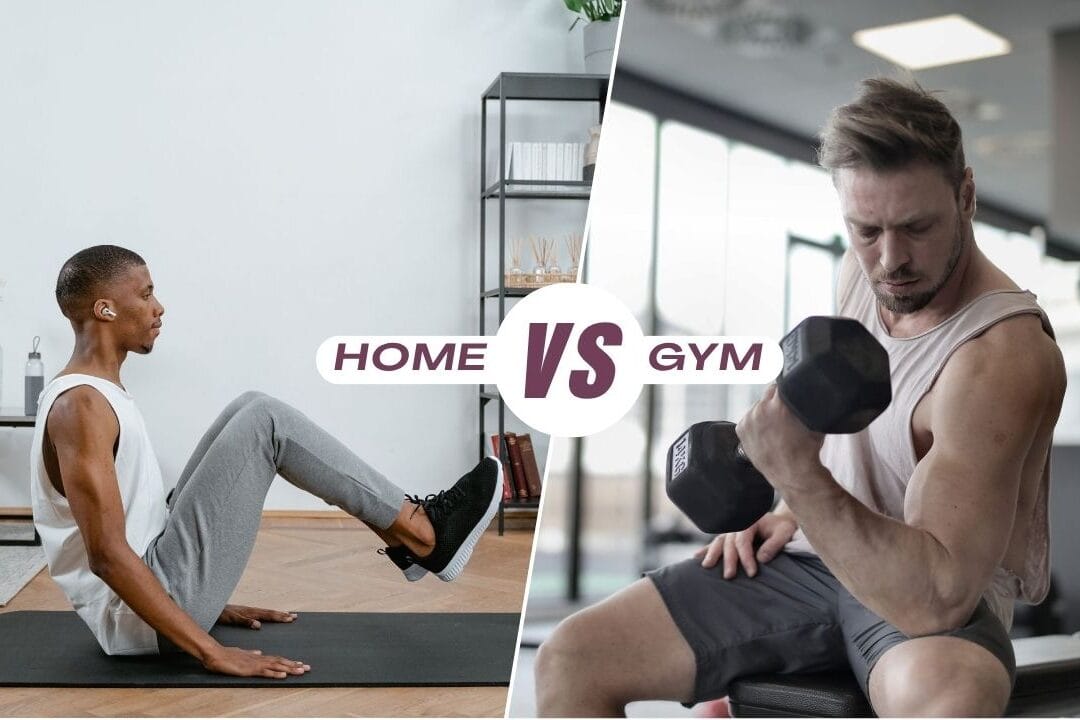
Let’s be honest: deciding where to workout can be almost as difficult as deciding what workout to do.
Maybe you’ve been thinking about joining a gym, but the membership fee feels unnecessary. Or perhaps you’ve tried working out at home, only to discover that your sofa, phone, and a dozen other distractions are surprisingly good at convincing you to skip leg day.
So which is actually better—home workouts or gym workouts?
The answer isn’t as simple as one being better than the other. Both can help you lose fat, build muscle, become stronger, and improve your overall fitness. Regular physical activity also provides broader health benefits, which is why finding an activity you can maintain long-term is so important. What matters most is choosing an approach that fits your lifestyle and, more importantly, one you can actually stick with.
Let’s look at the real differences between the two.
Home Workouts vs Gym Workouts at a Glance
| Factor | Home Workouts | Gym Workouts |
|---|---|---|
| Cost | Usually cheaper | Usually more expensive |
| Convenience | Excellent | Good |
| Travel time | None | Required |
| Equipment | Limited | Extensive |
| Muscle building | Very effective | Excellent |
| Strength development | Good to excellent | Excellent |
| Privacy | Excellent | Limited |
| Flexibility | Excellent | Good |
| Accountability | Depends on you | Often better |
| Best for | Convenience and flexibility | Equipment and advanced training |
But these categories don’t tell the whole story.
Your goals, personality, schedule, and motivation all matter.
1. Home Workouts Are Hard to Beat for Convenience
One of the biggest advantages of exercising at home is incredibly simple: You don’t have to go anywhere.
You can skip the traffic jams and the hunt for parking spaces. No waiting for a treadmill or squat rack. You can go from finishing work to putting on your workout clothes and exercising in minutes. That can be a big plus when life gets busy.
Let’s say you have 30 minutes available before work. If you’re going to the gym, part of that time may disappear while traveling and getting ready.
At home, you can use almost the entire 30 minutes for your workout. And sometimes that’s the difference between exercising and saying, “I’ll do it tomorrow.”
For busy parents, students, remote workers, and anyone with an unpredictable schedule, this convenience can make home workouts much easier to maintain.
Winner for convenience: Home workouts.
2. Home Workouts Can Save You Money
Gym memberships aren’t necessarily expensive, but they are another recurring expense. Depending on where you live and what gym you choose, you might also spend money on transportation, personal training, classes, or other extras.
Home workouts can be much cheaper. You can start with absolutely no equipment and use exercises such as the following:
- Squats
- Push-ups
- Lunges
- Glute bridges
- Planks
- Mountain climbers
- Burpees
Later, if you want more variety, you can gradually add resistance bands, dumbbells, kettlebells, or a pull-up bar. You don’t need to turn your spare room into a professional gym just to get started.
Winner for affordability: Home workouts.
3. The Gym Wins When It Comes to Equipment
This is where gyms have a major advantage. Walk into a well-equipped gym and you’ll probably have access to more equipment than you could realistically fit into your home. There may be:
- Barbells
- Dumbbells
- Cable machines
- Squat racks
- Bench presses
- Leg presses
- Treadmills
- Exercise bikes
- Rowing machines
- Resistance machines
That variety can be particularly useful if you’re serious about strength training or building muscle. At home, you can still make your workouts harder. You can add resistance, increase repetitions, slow down movements, change exercises, or buy additional equipment.
But eventually, some people reach a point where they simply need heavier weights.
Winner for equipment: Gym.
4. Can You Actually Build Muscle at Home?
Absolutely. You don’t need a gym membership to build muscle.
Your muscles don’t know whether you’re exercising in a commercial gym or in your living room. They respond to the training stimulus you give them.
For example, you might start with regular push-ups. Once those become easy, you could progress to the following:
Push-ups → feet-elevated push-ups → weighted push-ups
The same idea applies to your legs:
Bodyweight squats → Bulgarian split squats → goblet squats → heavier squats
This is called progressive overload—gradually making your training more challenging over time.
For beginners and many intermediate exercisers, home workouts can provide plenty of opportunities to progress. However, if you’re an advanced lifter trying to maximize muscle size or strength, a gym will usually make things easier because you have access to much heavier and more varied resistance.
For general muscle building: Both can work.
For advanced bodybuilding and strength: The gym usually wins.
5. Is the Gym Better for Losing Weight?
Not necessarily. This is one of the biggest misconceptions about fitness.
You don’t need a gym to lose weight. Walking, running, cycling, home workouts, sports, resistance training, and other forms of physical activity can all contribute to an active lifestyle. You can get a good workout at home using:
- Bodyweight circuits
- Jumping rope
- Dance workouts
- HIIT
- Step exercises
- Resistance bands
- Dumbbells
A gym simply gives you more options. You might use a treadmill one day, a rowing machine the next, and weights after that.
But the most sophisticated gym in the world won’t help much if you rarely go. For weight loss, your overall diet, activity level, consistency, and lifestyle matter much more than whether your workout happens in a gym.
And remember, fitness doesn’t have to mean intense workouts every day. Simple activities such as walking for better fitness can also help you stay active.
Winner for weight loss: It’s a tie.
6. Motivation Can Change Everything
This is where things get personal. Some people walk into a gym and immediately feel motivated.
Seeing other people exercising can create a sense of accountability. You might even find yourself pushing a little harder because everyone around you is training.
But not everyone feels that way. Some people hate crowded gyms. Others feel uncomfortable exercising around strangers or worry that they’re doing an exercise incorrectly. For those people, home workouts can feel much more comfortable.
Of course, home workouts come with their own problem: distractions.
Your phone is right there. Your bed is right there. The TV is right there. And suddenly, your planned 30-minute workout turns into 45 minutes of scrolling.
So ask yourself an honest question:
Where am I more likely to actually finish my workout?
That answer may be more important than which option looks better on paper.
7. Home Workouts Can Make Busy Days Easier
You don’t always need an hour-long workout. Sometimes you only have 20 or 30 minutes.
That’s okay.
A short workout is still better than doing nothing. For example, you could put together a quick home session using:
3 rounds:
- 12 squats
- 10 push-ups
- 10 reverse lunges per leg
- 12 glute bridges
- 30-second plank
Add a few minutes of warming up and cooling down, and you’ve got a simple workout without leaving the house. That flexibility is one of the biggest reasons home workouts work so well for busy people.
You can train early in the morning, during a lunch break, or after work. There’s no commute involved.
8. Gyms Give You More Variety
If you get bored easily, the gym may have the advantage. Instead of doing the same handful of exercises at home, you can constantly change your training.
For example, when training your chest, you might use:
- Barbell bench press
- Incline dumbbell press
- Machine chest press
- Cable fly
- Dumbbell fly
You can also change your workouts based on your goals.
Want to focus on strength? There are exercises for that.
Want to improve cardio? There are machines for that.
Want to train your legs? You have plenty of options.
But remember: more equipment doesn’t automatically mean better results.
A simple workout that you consistently complete is much more valuable than an impressive-looking program that you abandon after two weeks.
9. Home Workouts Can Feel Less Intimidating
Starting a fitness routine can be intimidating. Especially if you’ve never been to a gym before.
You might wonder:
“Am I using this machine correctly?”
“Is everyone looking at me?”
“What am I supposed to do after this exercise?”
Working out at home removes many of those worries.
You can take your time and follow a beginner workout video. You can pause when you need to. And nobody cares if you need three attempts to figure out how to do a new exercise.
For some beginners, that comfortable environment makes it easier to develop confidence before eventually moving into a gym.
10. The Gym Can Give You More Accountability
Here’s one problem with working out at home: It’s very easy to skip.
Nobody is waiting for you. Nobody knows you planned to exercise. And there’s always tomorrow.
A gym can create a little more commitment. Once you’ve driven there, changed clothes, and started your workout, you’re much less likely to turn around and go home. You can also train with a friend, join a class, or work with a personal trainer.
If you know you need external accountability to stay consistent, a gym might be the better environment for you.
11. What If Your Goal Is Getting Stronger?
If becoming significantly stronger is your main goal, the gym usually has the advantage. Strength requires you to progressively challenge your muscles.
Home workouts can absolutely make you stronger, especially when you’re starting out. But eventually, you may reach the limits of your available equipment.
If your heaviest dumbbells are no longer challenging enough, what do you do? You can make exercises harder, but eventually you may simply need more weight.
A gym gives you access to heavier resistance and equipment designed specifically for strength training. For goals involving serious strength development, powerlifting, or advanced bodybuilding, that’s a major advantage.
Winner for maximum strength: Gym.
12. What Should Beginners Choose?
If you’re new to fitness, don’t spend weeks worrying about whether home workouts or gym workouts are “perfect.” Start somewhere.
If a gym makes you uncomfortable, start at home. Or if you enjoy the gym atmosphere, join a gym. If you prefer walking and home strength workouts, do that.
The goal at the beginning isn’t to create the most complicated fitness program imaginable. It’s to build the habit of exercising. Learning how to build a sustainable fitness routine can help you stay consistent long enough to actually see results.
Once exercise becomes part of your routine, you can gradually make your workouts longer, harder, and more structured.
The Biggest Factor Isn’t Home vs Gym
Here’s the truth that gets overlooked in almost every home workout vs. gym debate:
Consistency matters more than location.
Imagine two people. Person A pays for an expensive gym membership but goes twice a month. Person B works out at home for 30 minutes four times a week.
Who is more likely to see results?
Probably Person B.
The gym doesn’t build muscle for you. The treadmill doesn’t burn calories by itself. And a $2,000 home gym doesn’t automatically make you fit.
You have to use the equipment.
The best workout is the one you can perform consistently and progress over time.
So, Which One Should You Choose?
There’s no reason to force yourself into one option.
Home workouts may be better for you if:
- You have a busy schedule
- You want to keep costs low
- You prefer privacy
- You don’t enjoy crowded gyms
- You want maximum flexibility
- You’re just getting started
- You can motivate yourself at home
A gym may be better if:
- You want access to lots of equipment
- You’re serious about strength training
- You want to build significant muscle
- You need heavier weights
- You enjoy the gym environment
- You like training with other people
- You benefit from professional guidance
And there’s a third option.
You can do both.
There’s no rule saying every workout has to happen in the same place. You could lift weights at the gym two or three days per week and do short home workouts on the days in between. For example:
- Monday: Gym strength training
- Tuesday: Home workout
- Wednesday: Rest
- Thursday: Gym strength training
- Friday: Home workout
- Saturday: Walking or outdoor activity
- Sunday: Rest
A hybrid approach gives you the best of both worlds.
Conclusion
So, home workouts vs. gym workouts—which is better for results? The answer depends on you.
Home workouts are fantastic if you value convenience, flexibility, privacy, and affordability.
Gyms are excellent if you want more equipment, heavier resistance, variety, and an environment that helps keep you accountable.
But here’s the question that matters most:
Which option can you realistically keep doing for the next six months?
If the answer is your living room, work out at home. Or if it’s the gym, join the gym. But if you like both, use both.
You don’t need the perfect workout setup. You don’t need the most expensive equipment. And you definitely don’t need to wait for the “right time” to start. You just need to start—and keep going.
Because the best workout isn’t the one that looks impressive on paper. It’s the one you actually do.
The real winner?
Consistency.
Whether you’re lifting weights in a gym or doing squats in your living room, the most effective workout is the one you can keep showing up for.
F.A.Q.
Yes. Home workouts can be highly effective for improving fitness, strength, endurance, and body composition when they are properly structured and progressed. A gym provides more equipment and resistance options, which can become particularly useful for advanced strength and bodybuilding goals.
Yes. Bodyweight exercises, resistance bands, dumbbells, kettlebells, and other home equipment can stimulate muscle growth. Progressive overload and adequate nutrition are important.
Usually. Bodyweight workouts can cost virtually nothing, while a basic collection of home equipment can be purchased gradually. However, a fully equipped home gym can eventually become expensive.
Not necessarily. Weight loss doesn't require a gym. Home workouts, walking, running, cycling, sports, and other forms of physical activity can all contribute to an active lifestyle.
For general health, adults should aim for at least 150 minutes of moderate-intensity aerobic activity per week and muscle-strengthening activities on at least two days per week.
Either is fine. Choose the environment where you feel comfortable and are most likely to remain consistent. Starting with manageable workouts and gradually increasing your training is a sustainable approach.