
Few mysteries of the ancient world have seized people’s imaginations. Atlantis is one of those.
For centuries the thought of a great civilization swallowed by the sea has captured the imaginations of explorers, historians, filmmakers, and dreamers. Documentaries, books, movies, and conspiracy theories have all kept the legend of Atlantis alive. It is a simple yet fascinating question:
What if it was true?
Though most experts think Atlantis was a myth fabricated by the ancient philosopher Plato, others say the story could have been inspired by real events or even a real civilization that disappeared long ago.
So, where’s the truth? Let’s get into the mystery.
Where Does the Story of Atlantis Come From?
The story of Atlantis begins with the ancient Greek philosopher Plato, who wrote of it around 360 BC.
Plato wrote of Atlantis in two of his dialogues, Timaeus and Critias. He described Atlantis as a wealthy island nation beyond the Pillars of Hercules (now the Strait of Gibraltar).
He described Atlantis as the following:
- Wealthy and powerful
- Well organized
- High in architecture and engineering
- Dominant at sea
- Brave enough to try to conquer neighboring lands
But there was a catch.
As Atlantis grew in power, the Atlanteans grew arrogant and corrupt. In retaliation, the gods punished the civilization, and it was swallowed by the sea in a cataclysm.
A dramatic story—but was Plato writing history or teaching a lesson?
Why Most Historians Believe Atlantis Was a Myth
Most historians and archaeologists agree that Atlantis was never intended to be taken literally. There are a couple of reasons why.
1. No records made before Plato
One of the biggest problems with the Atlantis theory is that there are no references to it by any known civilization before Plato. The ancient Egyptians, Greeks, and Mesopotamians also kept detailed records of major events and kingdoms. And yet, there is no mention of Atlantis anywhere else on its own.
That’s a pretty big gap for a civilization supposedly powerful enough to dominate much of the known world.
2. Plato was fond of allegories
Plato frequently employed fictional situations to probe political and philosophical ideas. Many scholars believe that Atlantis was his way of showing what happens when a society becomes too greedy, proud, or power-hungry.
In that reading, Atlantis is not a historical location; it is a warning.
3. No Archaeological Evidence
For centuries, archaeologists have searched for evidence of Plato’s Atlantis, but nothing convincing has ever been found. No city ruins, inscriptions, or artifacts have ever been conclusively connected to the legendary civilization.
That doesn’t mean people haven’t looked for it. They sure have.
The Real Civilization That Could Have Inspired Atlantis
One of the more popular theories is that Atlantis was the ancient Minoan civilization.
The Minoans, one of the most advanced civilizations of their day, flourished on the island of Crete thousands of years ago. They built impressive cities, set up extensive trade networks, and became a dominant maritime power in the Mediterranean. Then disaster happened.
Around 1600 BCE, the nearby volcanic island of Santorini erupted in one of the largest eruptions known in human history. The explosion must have led to gigantic tsunamis and destruction around the area. Some researchers believe that stories of this catastrophe may have been passed down through the generations and ultimately inspired Plato’s Atlantis story.
And although the Minoan civilization remains one of the strongest historical inspirations for Atlantis, it’s not the only theory. Lately, attention has been focused on a spectacular geological formation in the Sahara Desert, which is said to be a better fit to Plato’s description than anywhere else on earth.
The Richat Structure: Atlantis, or Geological Coincidence?
If you’ve ever spent any time looking at Atlantis theories on the internet, then you’ve probably come across the Richat Structure, aka the “Eye of the Sahara.”
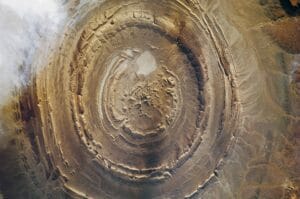
This huge circular feature is located in the arid desert of Mauritania, is about 40 kilometers (25 miles) across, and can be seen from space. On first glance, it’s easy to understand why Atlantis fans are fascinated by it.
Plato described Atlantis as a city with rings of land and water surrounding a central island. And from above, the concentric rings of the Richat Structure look a lot like that. For some researchers and independent investigators, the resemblances go even further. They mention that the size of the structure is similar to the measurements given by Plato.
Geological evidence also suggests a much greener Sahara in the past, with rivers, lakes, and plenty of wildlife. Thousands of years ago, the region was a dramatically different place than the desert we see today.
Some have postulated a flourishing civilization in this area before the climate changes that rendered the area uninhabitable. But there is a major flaw in the theory.
Geologists have studied the Richat Structure in great detail and found no evidence to suggest it was a man-made city. Instead, they discover it’s a natural formation of uplifted rock layers and millions of years of erosion.
There are no temples, no roads, no ports, no inscriptions, and no artifacts to prove the presence of an advanced lost civilization.
In other words, the Richat Structure is still one of the most interesting “what if?” sites on Earth—but not evidence of Atlantis.
Is Atlantis down there somewhere?
One of the things that makes Atlantis so interesting is the idea that we simply haven’t found it yet. After all, much of the ancient world lies under the sea.
The melting glaciers caused a dramatic rise in sea levels when the last Ice Age ended. Entire coastal landscapes were submerged. Some researchers have started to wonder if forgotten civilizations and ancient settlements are still lurking beneath today’s oceans.
There is speculation after several discoveries under the water.
Yonaguni Monument (Japan)
Near Japan, there is a mysterious underwater structure called the Yonaguni Monument. Some people have thought that it was built by humans due to its angular sharpness and geometric look.
Most geologists disagree. They say that natural geological processes can create similar formations.
Bimini Road (Bahamas)
Off the coast of the Bahamas, a line of stone blocks under the water is called the Bimini Road. To the faithful it looks like a fragment of an ancient road or harbor. To most scientists, it is a naturally occurring rock formation.
The argument goes on.
The Theory of an Advanced Lost Civilization
Some Atlantis buffs go even further. They propose that Atlantis could have been a prehistoric civilization that existed before recorded history and was destroyed by a worldwide catastrophe.
Supporters often say:
- Massive ancient monuments
- Precise stone construction
- Global flood legends
- Unsolved archaeological mysteries
These are interesting ideas, but at present there is no evidence of a technologically advanced civilization before the earliest known ancient cultures.
Archaeologists are still making discoveries, but they haven’t confirmed the existence of Atlantis.
Why Flood Myths Are Common Across Cultures
Flood myths are almost universal. This lends some credence to Atlantis. Across cultures and continents, there are stories of devastating floods, including the following:
- The story of Noah’s Ark in the Bible
- Flood stories of ancient Mesopotamia
- Indian flood myths
- Indigenous traditions across the globe
These stories may preserve memories of real disasters suffered by ancient communities. Thousands of years ago, whole settlements could have been lost as coastlines shifted with rising sea levels, tales that became legends.
Atlantis may just be one version of that collective human memory.
What Does Science Say Today?
Modern archaeology is open-minded but cautious. Scientists agree on a few things:
- Ancient civilizations were often more advanced than people used to think.
- Catastrophic natural disasters have repeatedly changed the course of human history.
- Many ancient settlements have gone under.
But researchers have yet to find evidence for Atlantis itself.
The lost city is not a matter of history for the moment but of mystery.
Why We Still Love Atlantis
Perhaps the greatest reason Atlantis persists in popular culture is that it tugs at a deeper chord. The legend is a blend of a few ideas that humans naturally find irresistible:
- Concealed knowledge
- Forgotten civilizations
- Catastrophic-scale disasters
- Exploration and discovery
- The possibility that history still has secrets
Atlantis teaches us that despite the age of satellites and advanced technology, there are still unanswered questions about our past. And sometimes answers aren’t as powerful as mysteries.
Conclusion
Could Atlantis Have Been Real? The most honest answer is maybe—but probably not in the way the legend describes.
Most historians still view Atlantis as a fictional story created by Plato to teach moral and political lessons. However, theories involving the Minoan civilization, ancient flood events, submerged settlements, and even the Richat Structure in Mauritania continue to fuel debate and curiosity.
Yet the story may have been inspired by real events, such as the destruction of the Minoan civilization, ancient volcanic eruptions, or communities lost beneath rising seas.
Was it a real place? A twisted memory of past disasters? Or just a great piece of philosophy? But whatever the truth, Atlantis continues to capture our imagination more than two thousand years after it was first written down.
So until the last proof is found, the lost city of Atlantis will remain one of the greatest unsolved mysteries in history.