
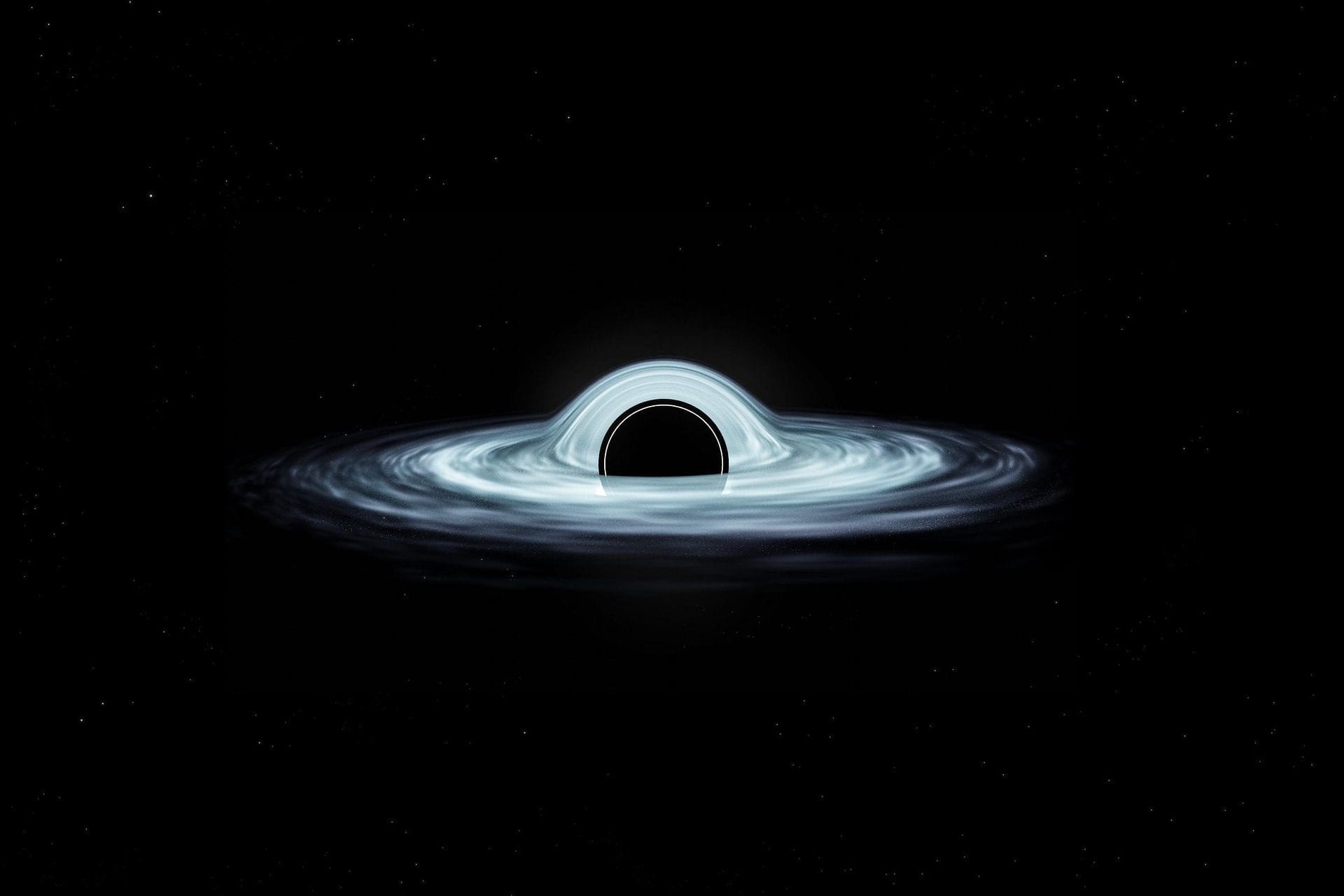
Black holes are some of the most mysterious and scary things out there. They eat light, distort time itself, and test everything we know about physics. But after decades of research, scientists still don’t quite understand what’s truly going on inside one.
At the center of each black hole is a point where the known laws of physics cease to apply—the singularity.
But is a black hole the end of existence?
Or maybe it’s a doorway into something else?
What Is a Black Hole?
When a star runs out of nuclear fuel, it collapses under its own gravity. If it is huge enough, this creates a black hole. The rest of the core becomes so dense that gravity wins out over all other forces in nature.
This creates a region of space from which there is no escape. Light itself cannot get out. That’s why black holes are completely dark.
The Event Horizon
The event horizon is the boundary around a black hole. Once anything passes this invisible line, it cannot get away. The escape velocity is faster than the speed of light.
$$
v_e = \sqrt{\frac{2GM}{r}}
$$
This equation is the velocity of escape. Gravity in black holes is so extreme that it is faster than the speed of light outside the event horizon.
What Would Happen If You Fell Into One Of These?
Strangely enough, the answer depends on the size of the black hole.
Small Black Holes: Instant Death
In smaller black holes, gravity varies strongly over short distances. Your feet would have far more gravity than your head. This leads to a process known to scientists as spaghettification.
Your body would be stretched into an infinitely thin strand of matter before it even reached the center. Imagine getting torn apart atom by atom.
Supermassive Black Holes: More Curious Fate
The gravity difference near the event horizon of massive black holes, such as those at the centers of galaxies, is less extreme.
You could cross the event horizon and not notice anything odd at first. But what a horror-stricken outsider would see.
Near a black hole time slows down
The theory of relativity says gravity curves space and time. Time slows down a lot near a black hole.
$$
t’ = \frac{t}{\sqrt{1-\frac{2GM}{rc^2}}}
$$
This is known as gravitational time dilation.
To an observer on Earth:
- You would seem to move slower and slower
- Your signals would be redder and fainter
- You would seem to freeze forever at the event horizon
But from your point of view:
- Time feels like normal
- You keep falling inward
- The outside universe accelerates dramatically
In theory, you could see the far future of the cosmos in a matter of minutes.
The Singularity: Where Physics Fails
The singularity is at the center of a black hole.
A singularity is believed to be the following:
- infinitely thick
- infinitesimal
- a point at which the curvature of space-time is infinite
$$
\rho \rightarrow \infty
$$
Current physics cannot explain what goes on there.
Here is where
- General Relativity breaks down
- quantum mechanics goes unstable
- our knowledge of reality evaporates
Scientists hope that a future “theory of quantum gravity” will one day explain singularities. But for now, the heart of a black hole remains one of science’s great unsolved mysteries.
Black Holes as Portals?
Some theories say black holes don’t destroy matter at all.
They managed to connect to:
- wormholes
- parallel universes
- entirely different parts of spacetime
Wormholes
A wormhole is a hypothetical passage through space-time.
$$
ds^2 = -c^2dt^2 + dl^2
$$
Theoretically:
- One end could be a black hole
- the other could be born somewhere else in the universe
- or even a whole other universe
This notion appears in both theoretical physics and science fiction, like Interstellar. But there is no evidence for the real existence of traversable wormholes yet.
Are black holes portals to other universes?
Some cosmologists think black holes may give birth to “baby universes.”
In the theory:
- matter collapsing to a singularity causes a new big bang
- each black hole could spawn a whole new universe
- our universe could itself be inside a black hole
Such an idea ties black holes to the origin of reality itself. Speculative, but mathematically intriguing.
The Information Dilemma
One of the deepest controversies in modern physics is the black hole information paradox.
In quantum mechanics:
information can never truly be destroyed.
But black holes seem to erase all forever.
The contradiction has sparked decades of debate, with physicists such as Stephen Hawking weighing in.
Hawking Radiation
In 1974, Hawking suggested that over time black holes radiate and slowly evaporate.
$$
T_H = \frac{\hbar c^3}{8\pi G M k_B}
$$
This means that black holes aren’t entirely eternal. They may eventually disappear altogether after unimaginable lengths of time.
But if the black hole evaporates, where is the information going?
Scientists don’t know yet.
What Would You Actually See Inside
Nobody really knows what you would actually see inside a black hole.
Possible scenarios could be the following:
- impending ruin
- ultraquantum chaos
- curved spacetime geometry
- journey into a different reality
- total breakdown of the laws of physics
Our knowledge of the universe reaches its limit inside a black hole.
The frightening truth
Black holes are not just big vacuum cleaners in space.
They include:
- extreme physics laboratories
- distortions in space-time itself
- gateways to questions of reality left unanswered
They present humanity with terrifying possibilities:
- time may be not absolute
- space can fold in impossible ways
- there are extra dimensions in the universe
- reality may be weirder than we can imagine
And somewhere beyond the horizon, the answers are locked for eternity.
Conclusion
Black holes are the meeting point of science and the unknown.
They lie at the edge of what we can understand – where gravity is infinite, time means nothing, and the rules of reality seem to break down. Cosmic dead-ends, portals to other universes, keys to a deeper theory of existence.
One thing is for sure: The more we study black holes, the stranger the universe appears.
F.A.Q.
No known physics suggests survival is possible, though supermassive black holes may delay destruction temporarily.
Scientists believe a singularity exists at the center — a point of infinite density.
Time slows dramatically near black holes due to gravitational time dilation.
Some theories suggest wormholes or baby universes may connect to black holes, but there is no evidence yet.
According to Hawking radiation theory, black holes slowly evaporate over extremely long timescales.