Imagine looking into the night sky and seeing nothing unusual. No approaching asteroid. No strange glow. No warning sirens.
Then, somewhere thousands of light-years away, a dead star suddenly releases an extraordinary blast of high-energy radiation. The flash itself might last only seconds. Yet under the right circumstances, its effects on Earth could continue for years.
This is the unsettling science behind magnetars and gamma-ray bursts—two of the most extreme phenomena in the universe.
So, could there really be a star that could destroy Earth?
Not in the Hollywood sense of blowing our planet apart. However, a sufficiently powerful and nearby burst aimed in our direction could potentially damage Earth’s atmosphere and severely disrupt the biosphere. Fortunately, there is an equally important part of this story:
There is no evidence that such a catastrophe is about to happen.
What Is a Magnetar?
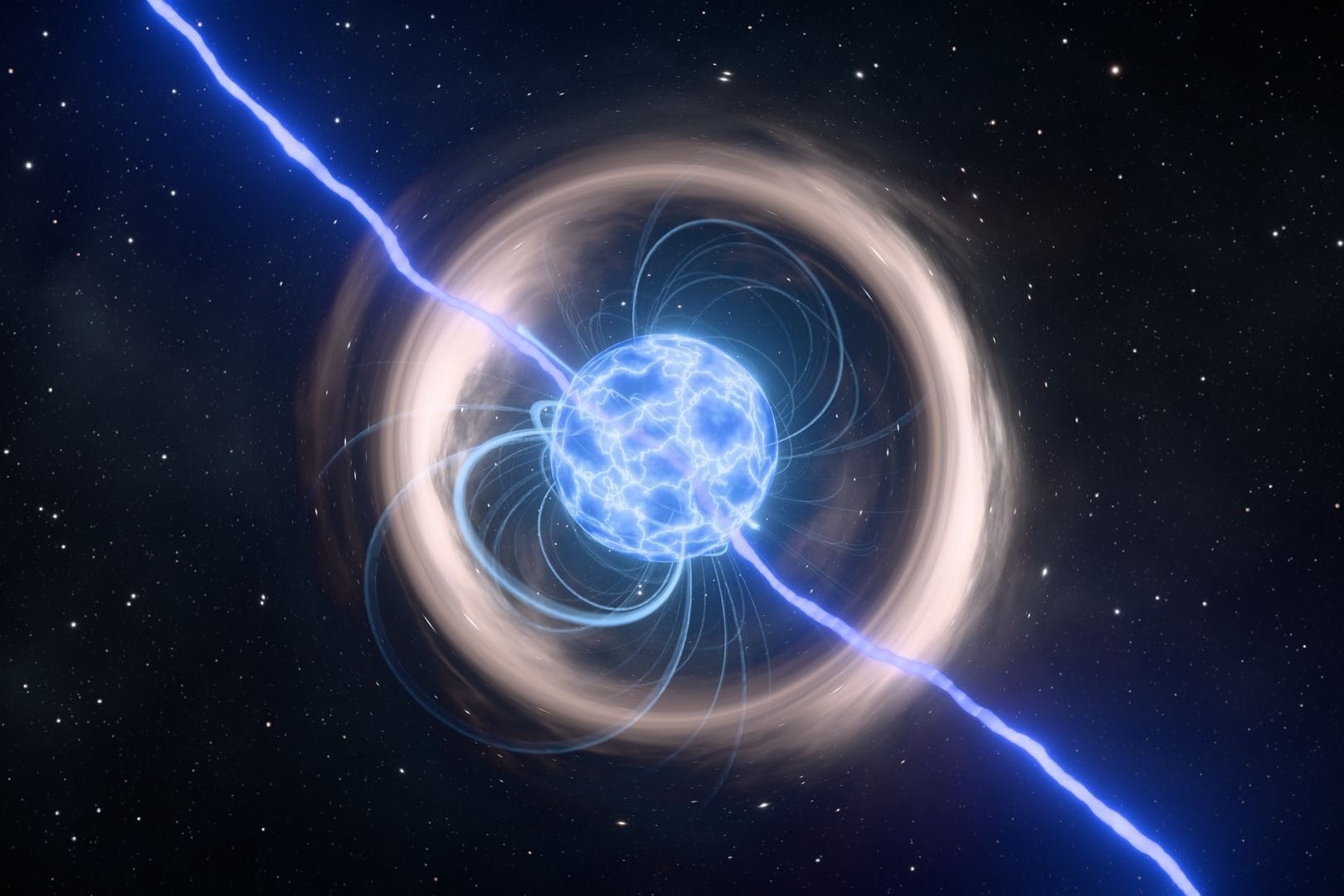
A magnetar begins with the death of a massive star. After certain massive stars explode as supernovae, their cores collapse into incredibly dense objects called neutron stars. A neutron star can contain more mass than the Sun compressed into an object roughly the size of a city.
Magnetars are an especially extreme class of neutron star. Their magnetic fields are among the strongest known anywhere in the observable universe. NASA describes magnetars as possessing magnetic fields vastly stronger than anything humans can produce and more than a trillion times stronger than Earth’s magnetic field.
In 2026, NASA reported new observations of the magnetar 1E 1547.0-5408 using the Imaging X-ray Polarimetry Explorer, or IXPE. The measurements provided some of the strongest observational evidence yet for an exotic quantum effect known as vacuum birefringence, showing just how extreme the environment surrounding a magnetar can become.
These strange objects are small, dense, and extraordinarily energetic. Yet their magnetic fields are only part of what makes them frightening.
Magnetars Can Suddenly Erupt
A magnetar’s magnetic field stores tremendous amounts of energy. Over time, stresses within the star’s crust and magnetic environment can produce bursts of X-rays and gamma rays. Most of these eruptions are relatively modest on cosmic scales.
Very rarely, however, a magnetar can unleash a giant flare. We have actually seen one affect Earth.
On December 27, 2004, a magnetar known as SGR 1806-20, located roughly 50,000 light-years away, produced an enormous gamma-ray flare.
The brightest part lasted only a fraction of a second. Despite the incredible distance, the radiation was strong enough to disturb Earth’s upper atmosphere and alter the ionosphere. The planet itself remained perfectly intact.
That real event illustrates an important point: powerful radiation from a magnetar can reach Earth across enormous distances, but distance dramatically reduces its intensity.
Move an event like that much closer, however, and the situation becomes more interesting.
Gamma-Ray Bursts: The Universe’s Most Powerful Explosions
Magnetar flares are not the only danger. Another phenomenon is even more energetic: the gamma-ray burst, usually shortened to GRB.
Gamma rays are the highest-energy form of electromagnetic radiation. A gamma-ray burst can release an astonishing amount of energy during a very short period.
NASA describes GRBs as the most powerful explosions known in the universe. Some can momentarily reach luminosities enormously greater than the Sun.
Astronomers traditionally divide them into two broad groups.
Short Gamma-Ray Bursts
These have initial gamma-ray emission lasting less than about two seconds. Many short GRBs are associated with catastrophic mergers involving compact objects, especially two neutron stars or, in some cases, a neutron star and a black hole.
Such mergers can also produce kilonovae and gravitational waves. Interestingly, some extremely short gamma-ray signals can also come from giant magnetar flares in relatively nearby galaxies.
Long Gamma-Ray Bursts
Long GRBs generally last longer than two seconds and are commonly associated with the deaths of massive stars. As the core of a massive star collapses, it can produce a compact remnant and extraordinarily energetic jets.
If one of those jets happens to point toward Earth, we observe a gamma-ray burst. That direction matters enormously.
A Gamma-Ray Burst Is More Like a Cosmic Searchlight
A common misconception is that gamma-ray bursts throw their destructive energy equally in every direction. Many GRBs instead concentrate much of their high-energy output into narrow jets.
Imagine a lighthouse. The lighthouse itself may be extremely bright, but you only see its strongest beam when it sweeps across you.
A GRB operates on an incomparably more energetic scale. Earth would therefore need to be positioned within or near the direction of a sufficiently close burst’s jet for the most serious effects to occur.
The star exploding somewhere in the Milky Way would not automatically mean disaster. Distance, energy, and orientation all matter.
What Would Happen If a Powerful GRB Hit Earth?
Here is where the idea of a star that could destroy Earth becomes more scientifically interesting.
The planet probably would not explode. Oceans would not instantly boil away, and Earth’s crust would not suddenly disintegrate.
Instead, much of the immediate gamma radiation would interact with the atmosphere. That interaction could trigger atmospheric chemistry with consequences far longer-lasting than the original flash.
1. The Upper Atmosphere Would Absorb the Radiation
Earth’s atmosphere provides an enormous amount of protection against high-energy radiation. Gamma rays entering the atmosphere collide with molecules rather than simply passing unhindered to the ground.
That is good news for life on the surface. However, absorbing the energy does not mean nothing happens.
Atmospheric molecules can be ionized and broken apart, triggering new chemical reactions.
2. The Ozone Layer Could Be Damaged
One of the most serious modeled consequences involves ozone. The stratospheric ozone layer protects life from harmful ultraviolet radiation produced by the Sun.
NASA-associated atmospheric modeling examined a hypothetical 10-second gamma-ray burst delivering 100 kilojoules per square meter to Earth. In that modeled scenario, average global ozone depletion reached roughly 35%, with even greater losses at some latitudes. Significant depletion continued for years.
Those numbers are not a prediction of something currently heading toward Earth. They come from a hypothetical high-energy exposure model designed to understand what could happen under extreme conditions. Still, they demonstrate why gamma-ray bursts attract the attention of astrobiologists.
3. More Harmful Ultraviolet Radiation Could Reach the Surface
Once ozone levels fall, another danger appears. More ultraviolet-B radiation from the Sun can penetrate toward Earth’s surface.
That could increase DNA damage in exposed organisms. Ocean ecosystems could be especially vulnerable near the surface, where microscopic organisms such as phytoplankton form the foundation of enormous food webs.
A serious disruption at that level could spread through ecosystems. The surprising part is that the GRB itself might already be over.
A burst lasting only seconds could potentially alter atmospheric chemistry for years.
Could a Gamma-Ray Burst Cause a Mass Extinction?
Possibly—but this remains a hypothesis. Scientists have investigated whether an ancient gamma-ray burst could have contributed to one of Earth’s historical mass extinctions, particularly the Late Ordovician extinction roughly 445 million years ago.
Atmospheric models show that a sufficiently strong GRB could produce ozone depletion, increased ultraviolet exposure, and other environmental changes consistent with biological stress.
However, researchers do not have direct evidence showing that a gamma-ray burst actually caused that extinction.
The idea is scientifically interesting because the mechanism is physically plausible, not because the event has been proven. This distinction matters when discussing catastrophic cosmic events. Cosmic catastrophes such as gamma-ray bursts have even been discussed as one possible obstacle to the long-term survival of advanced civilizations in theories about the Great Filter.
Cosmic Radiation Is More Complicated Than It Sounds
The phrase “cosmic radiation” is often used as though it refers to one thing.
It does not.
Gamma rays are extremely energetic photons—particles of light. Cosmic rays, despite their name, are mostly high-energy charged particles such as protons and atomic nuclei moving through space.
They can originate from powerful environments, including supernova remnants and other energetic astrophysical sources.
Earth receives cosmic radiation constantly. Fortunately, our planet has two major protective systems: its atmosphere and magnetic field.
The magnetic field redirects many charged particles, while the atmosphere absorbs or transforms much of the incoming radiation before it can reach the surface. That shielding is one reason life can survive on Earth despite living in a universe filled with energetic particles.
Leave Earth’s protection, however, and radiation becomes a much more serious challenge. In fact, exposure to space radiation is one of the major problems humans would need to overcome to survive on Mars.
Would Cosmic Radiation Kill Everyone Instantly?
Probably not in the scenario most scientists consider plausible. For a powerful GRB, the more important global biological danger would likely come from atmospheric changes rather than every organism receiving an instantly lethal direct dose of gamma radiation at ground level.
Research published in 2024 also highlighted how effectively Earth’s atmosphere can shield the biosphere from some forms of intense astrophysical radiation.
That does not make extreme events harmless. It shows that the relationship between cosmic explosions and life on Earth is more complicated than the simple idea of a radiation beam instantly burning the surface.
Could a Magnetar Literally Destroy Earth?
For a known magnetar at normal astronomical distances, no. A magnetar would need to be extraordinarily close for its magnetic field itself to become a direct physical threat to Earth.
The more realistic concern is radiation from a giant flare. The 2004 flare from SGR 1806-20 is the perfect example. It altered Earth’s upper atmosphere from about 50,000 light-years away, yet caused no known biological catastrophe.
Distance saved us from anything more serious. If an equally powerful source were dramatically closer, the radiation received by Earth would be much stronger.
But there is a huge difference between saying a close event could threaten life and claiming a known magnetar is currently preparing to destroy Earth.
Is There a Dangerous Gamma-Ray Burst Heading Toward Us?
There is currently no evidence of an imminent gamma-ray burst threatening Earth. GRBs detected by astronomers overwhelmingly come from enormous cosmic distances. NASA notes that the closest GRB on record occurred more than 100 million light-years away.
Events that distant may be spectacular to telescopes, but they are not extinction threats to Earth. Astronomers nevertheless continue studying massive stars, neutron stars and magnetars because these objects teach us how matter behaves under conditions impossible to recreate on Earth.
Observatories such as NASA’s Fermi Gamma-ray Space Telescope, Swift, IXPE and other space missions help researchers detect and analyze these energetic events.
The Brightest Gamma-Ray Burst Ever Recorded
One event demonstrated just how powerful GRBs can become. On October 9, 2022, radiation from GRB 221009A swept through the solar system.
The event became known as the BOAT—the Brightest Of All Time. It was so intense that several gamma-ray detectors in space were temporarily overwhelmed.
Scientists estimated that a burst of comparable brightness reaching us may be extraordinarily rare. Yet even this extraordinary event originated at a cosmological distance and did not threaten life on Earth.
Once again, distance made all the difference.
So, What Is the Star That Could Destroy Earth?
There probably isn’t one specific known star waiting to erase us. The more accurate answer is that several types of extreme stellar events could become dangerous under the right circumstances.
A nearby magnetar could unleash an enormous giant flare. A massive star could collapse and launch a gamma-ray burst. Two neutron stars could merge and produce another type of high-energy explosion.
For Earth to face truly catastrophic consequences, however, the event would need the right combination of enormous energy, relatively close distance and—in the case of a strongly beamed GRB—unfortunate alignment.
That combination appears to be extraordinarily rare.
The Universe Is Violent, but Earth Is Well Protected
Space contains phenomena far more powerful than anything humanity has ever created.
Stars explode. Neutron stars collide. Black holes form. Magnetars unleash giant flares. Gamma-ray jets cross entire galaxies.
Some of those events release more energy in seconds than our Sun will produce across billions of years. Yet Earth has survived for more than four billion years.
Our atmosphere, magnetic field and sheer astronomical distance from most cosmic catastrophes provide remarkable protection.
So the phrase “the star that could destroy Earth in seconds” contains a grain of scientific truth—but the real story is much more fascinating than the headline.
A cosmic flash might last only seconds. The planet would probably remain intact.
But under an extraordinarily unlucky set of circumstances, those few seconds could change Earth’s atmosphere—and possibly life on the planet—for years to come.
F.A.Q.
A known magnetar is extremely unlikely to physically destroy Earth. The more plausible danger would come from an exceptionally powerful giant flare occurring much closer than known historical examples, potentially affecting Earth's atmosphere.
A sufficiently powerful nearby GRB aimed toward Earth could ionize the atmosphere, damage the ozone layer and increase the amount of harmful ultraviolet radiation reaching the surface. Atmospheric modeling has found substantial ozone depletion in extreme hypothetical scenarios.
The initial gamma-ray flash could last from fractions of a second to minutes. Atmospheric chemical changes triggered by an extreme burst, however, could persist for years.
Yes. The December 27, 2004, giant flare from magnetar SGR 1806-20 disturbed Earth's ionosphere despite originating roughly 50,000 light-years away.
There is no evidence of an imminent GRB threatening Earth. NASA reports that the closest GRB on record occurred more than 100 million light-years away.
No. Gamma rays are high-energy photons, while cosmic rays are primarily energetic charged particles such as protons and atomic nuclei.