
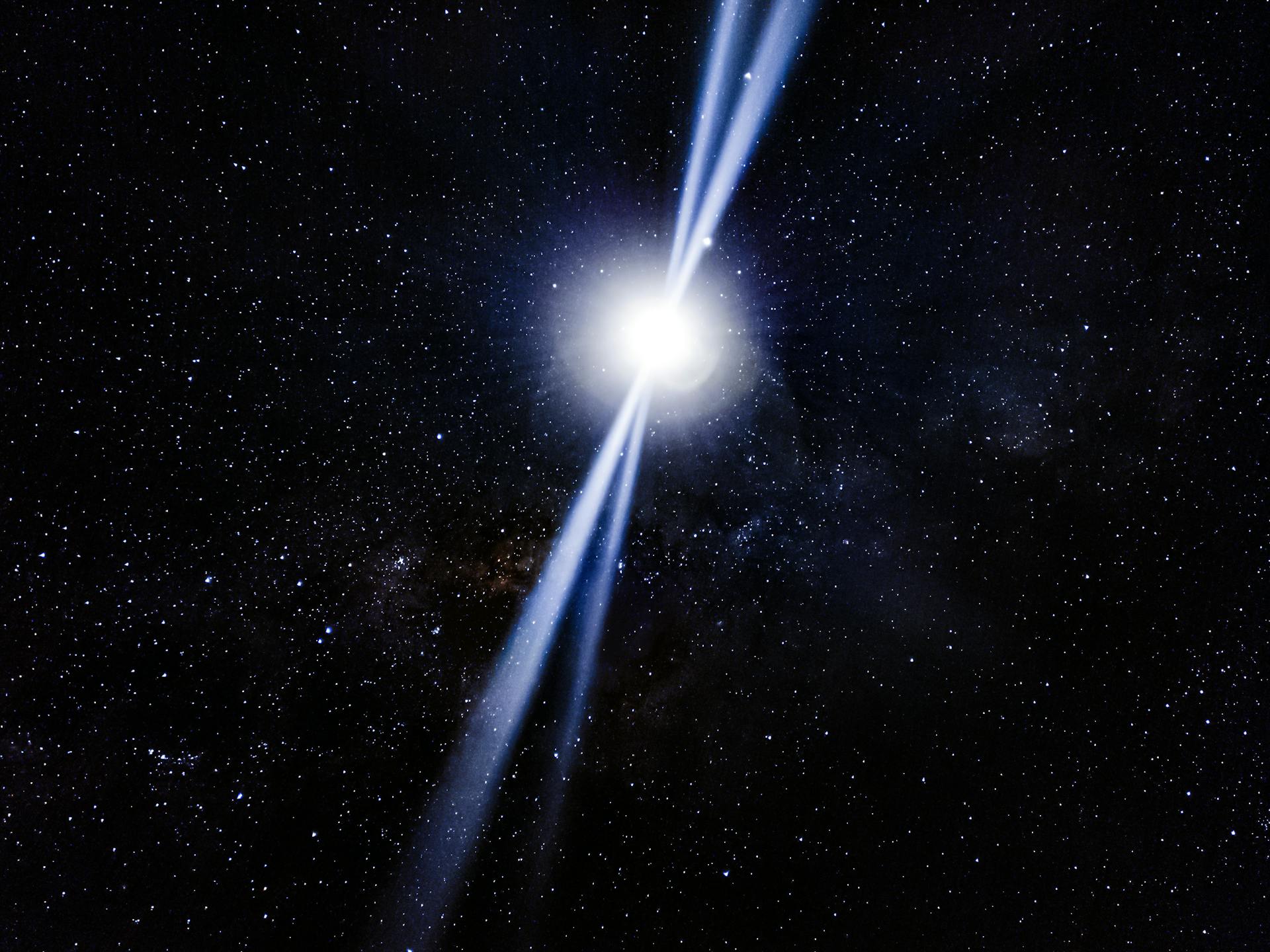
The Star That Could Destroy Earth in Seconds
Imagine waking up tomorrow and discovering that somewhere across the galaxy, a distant star has just unleashed enough energy to erase life on Earth—not through fire, asteroids, or alien invasion, but through invisible radiation traveling at the speed of light.
It sounds like science fiction, but the universe contains objects so powerful that they challenge imagination itself. Among them are magnetars and gamma-ray bursts (GRBs), two of the most extreme cosmic phenomena ever discovered.
The frightening part? Earth would have little to no warning.
What Is a Magnetar?
A magnetar is a rare type of neutron star—the dense leftover core of a giant star that exploded in a supernova.
If Earth were compressed into a sphere only about 20 kilometers across, it would resemble the density of a neutron star. Magnetars take things even further by possessing magnetic fields trillions of times stronger than Earth’s.
These objects are essentially cosmic monsters.
Scientists believe their magnetic fields can become unstable and suddenly rearrange themselves, creating enormous bursts of energy. These eruptions release intense X-rays and gamma rays into space.
Recent observations detected giant flares from distant magnetars capable of releasing in a fraction of a second as much energy as our Sun emits over thousands of years.
Gamma-Ray Bursts: The Universe’s Deadliest Flash
Gamma-ray bursts (GRBs) are considered the most energetic explosions known in the universe.
They occur when:
- Massive stars collapse into black holes
- Neutron stars collide
- Some newly formed magnetars release extraordinary amounts of energy
A GRB may last only milliseconds or several minutes, but during that brief period it can outshine entire galaxies.
Unlike a normal explosion, these events often fire energy into narrow beams rather than all directions.
Think of a lighthouse beam crossing the ocean.
If Earth happened to sit directly in the path of that beam, the consequences could be catastrophic.
What Would Happen If Earth Was Hit?
Scientists do not think Earth would instantly explode like a movie scene.
The damage would likely occur in stages:
Stage 1: Atmospheric destruction
Gamma radiation would slam into the upper atmosphere and begin stripping away ozone protection.
Research suggests significant ozone depletion could occur, allowing much larger amounts of harmful ultraviolet radiation to reach the planet.
Stage 2: Massive biological damage
Without enough ozone:
- DNA damage rates would rise
- Marine ecosystems could collapse
- Food chains could fail
- Plant and animal life would face severe stress
Studies suggest extreme events could dramatically increase biologically dangerous radiation exposure.
Stage 3: Global climate effects
Atmospheric changes could block portions of sunlight and alter climate patterns.
Scientists have even explored whether an ancient gamma-ray event might have contributed to large extinction events in Earth’s distant history, though this remains a hypothesis rather than established fact.
Could Earth Actually Be Destroyed in Seconds?
The short answer: probably not physically destroyed.
Popular headlines sometimes imply that a nearby magnetar would instantly vaporize Earth. Reality is more nuanced.
Current evidence suggests the biggest danger isn’t the planet exploding—it is the possibility of devastating radiation effects on Earth’s atmosphere and life systems. Extremely close events would be required for outright planetary destruction.
Are We Currently in Danger?
Fortunately, astronomers do not know of any nearby magnetars or gamma-ray burst sources pointed directly at Earth.
Most known GRBs occur in distant galaxies millions or billions of light-years away. Giant magnetar flares are also extremely rare.
The universe is dangerous, but space is also unimaginably large.
Distance is our shield.
Final Thoughts
Humanity often worries about threats close to home—storms, earthquakes, or asteroids. Yet some of the most powerful dangers exist far beyond our planet.
Magnetars and gamma-ray bursts remind us that the universe is both beautiful and terrifying. Somewhere in deep space, stars are collapsing, neutron stars are colliding, and invisible waves of radiation are racing across the cosmos.
Most will never reach us.
But if one ever did, Earth would experience one of the most dramatic events in planetary history.